Monday, January 22, 2007

Hi everyone...

I'm back. I was gone this past weekend on a discernment retreat. Developing a Discerning Heart, led by Pro Sanctity national director, Teresa Monaghan. Please visit the website and know that I am praying for all of you, and thank you all so much for your encouraging comments and taking time to stop by and 'visit' and post. This internet is so valuable in making the global Church small, intimate and nurturing the faith of so many of us. I don't know where all of you live, but wouldn't it be nice if we could meet someplace sometime this side of Heaven? I used to be a Glenn Beck listener, and huge fan, (now I'm praying for his return to his Catholic heritage/Faith.) In his forums there were so many like-minded fans that they'd find out where they all were and made time to gather for dinner/or even overnight somewhere and meet others fond of his program.

If they can do it, we can, too! We don't have a mere mortal in common, but Jesus and His Eucharist. What say you? Any of you near Omaha or are going to be near Omaha in the next year? Or perhaps we could all make plans to meet at EWTN next year for a pilgrimage and meet one another. Think about it. God Bless you. I'll be back online to visit your blogs, too. I don't get to do that as often as I'd like right now, but I'm glad we all have each other in this battle for souls that daily rages around us. The enemy is devious and crafty. Jesus is LORD of all and has WON our victory. We just need to pick up our crosses and meet a "Simon" now and then to help us on our bloody path. Praise God we're back Home and here for each other.

susie

Friday, January 19, 2007

Ignorance of Scripture is NOT Catholic!

Dr. Marcellino D'Ambrosio - Catholic Online Resources

by: Marcellino D'Ambrosio, PhD

To listen to this article as read by Dr. Marcellino D'Ambrosio, CLICK HERE!

Jesus reads Scripture Catholic Bible StudyThere is a myth that we must lay to rest, once and for all--Protestants are all about the Bible, while Catholics are all about the Sacraments. While I can’t speak for my Protestant brethren, I can say this with certainty–the Catholic Church has never tolerated any such either/or. Both Scripture and Sacraments are precious gifts from the Lord, gifts we desperately need and are bound to use.

“Ignorance of Scripture is ignorance of Christ!” insisted St. Jerome, an Early Church Father and Doctor of the Catholic Church from the 5th century AD. Because of this, every liturgical service of the Catholic Church is full of Scripture. Take Sunday Mass for instance. First there are significant chunks of Scripture read aloud, just as we see in Nehemiah 8 or in Luke 4 when Jesus serves as lector at the synagogue of Nazareth. But don’t forget the prayers and acclamations that are full of Scripture like the Holy Holy (a combo of Is 6 and Ps 118:26), the Our Father (Mat 6:9), and the Gloria (Lk 2:14). Ironically, many “Bible churches” that accuse Catholics of being non-scriptural don’t actually read any Scripture aloud in their Sunday service at all!

So is hearing Scripture on Sunday enough? Not by a long-shot. Scripture, says the Second Vatican Council (Dei Verbum 21), is “food for the soul.” Who eats just once a week? To survive and thrive, you need daily nourishment. You can have a steady diet of Scripture by attending Mass daily, participating in the liturgy of the hours with its daily readings and psalms, or reading Scripture in daily personal prayer. Actually, all three make an unbeatable combination.

Catholic Scripture Study Bible Time line, Jeff Cavins,

Frequently, though, when Catholics start reading the bible, they quickly run into trouble–usually in the first chapters of Leviticus! Yes, sometimes it is hard to know where to begin, to fit it all together, and to interpret correctly some rather obscure passages, words, and names. My father, who first attached the Bible at age 63, discovered the book of Malachi. Thinking the name was pronounced “ma-LA-chee”, he rejoiced that there was an Italian among the prophets.

There are great Catholic bible studies on books, tapes, videos, and the web. Some are book-by-book commentaries. Others are big-picture overviews of salvation history so that you can fit each book, character, and theme into the overall story of God’s dealings with his people. Most are conveniently designed so that busy people with no background in the Bible can learn a lot without a huge time commitment.

Many of us spend 16 or more years of our life preparing for our secular career, then take continuing ed courses on nights and weekends. In contrast, how much have we invested in our education in the Word of God, essential for our heavenly career?

Holy Spirit - Confirmation - Catholic Bible Study

The study of the Bible, is for one purpose, however. So that, praying with Scripture, we may be better able to hear what God is saying to us here and now. The writers of Sacred Scripture were inspired by the Holy Spirit. But it is equally true that the Scriptures themselves are inspired. The Holy Spirit has been “breathed into them” and resides within their words as in a temple. When we approach the Scriptures prayerfully, aided by the same Spirit who dwells in them, reading Scripture becomes an experience of being filled and empowered by God’s Spirit, and we are changed.

Sometimes the Words of Scripture are encouraging. Like when 1 Corinthians 12 tells us that no matter how insignificant we may feel, we each have an essential role to play as members of the Body of Christ. But other times Scripture holds a mirror up to our face and we don’t like what we see. In Nehemiah 8, the people wept at the reading of the word, because it made them realize their sin. The Word is truth, and sometime the truth is painful. But so is antiseptic on a wound. Scripture challenges us only to heal us and call us to growth. No pain, no gain.

Thursday, January 18, 2007

How Pius XII Protected Jews

By Jimmy Akin

The twentieth century was marked by genocides on an monstrous scale. One of the most terrible was the Holocaust wrought by Nazi Germany, which killed an estimated six million European Jews and almost as many other victims.

During this dark time, the Catholic Church was shepherded by Pope Pius XII, who proved himself an untiring foe of the Nazis, determined to save as many Jewish lives as he could. Yet today Pius XII gets almost no credit for his actions before or during the war.

Anti-Catholic author Dave Hunt writes, "The Vatican had no excuse for its Nazi partnership or for its continued commendation of Hitler on the one hand and its thunderous silence regarding the Jewish question on the other hand. . . . [The popes] continued in the alliance with Hitler until the end of the war, reaping hundreds of millions of dollars in payments from the Nazi government to the Vatican."[1]

Jack Chick, infamous for his anti-Catholic comic books, tells us in Smokescreens, "When World War II ended, the Vatican had egg all over its face. Pope Pius XII, after building the Nazi war machine, saw Hitler losing his battle against Russia, and he immediately jumped to the other side when he saw the handwriting on the wall. . . . Pope Pius XII should have stood before the judges in Nuremberg. His war crimes were worthy of death."[2]

One is tempted simply to dismiss these accusations, so wildly out of touch with reality, as the deluded ravings of persons with no sense of historical truth. This would underestimate the power of such erroneous charges to influence people: Many take these writers at their word.

Stepping out of the nightmare fantasyland of Hunt and Chick and back into sunlight of the real world, we discover that, not only was Pius XII no friend of the Nazis, but that his opposition to them began years before the War, before he was elected to the papacy, when he was still Cardinal Eugenio Pacelli, the Vatican Secretary of State.

On April 28, 1935, four years before the War even started, Pacelli gave a speech that aroused the attention of the world press. Speaking to an audience of 250,000 pilgrims in Lourdes, France, the future Pius XII stated that the Nazis "are in reality only miserable plagiarists who dress up old errors with new tinsel. It does not make any difference whether they flock to the banners of social revolution, whether they are guided by a false concept of the world and of life, or whether they are possessed by the superstition of a race and blood cult."[3] It was talks like this, in addition to private remarks and numerous notes of protest that Pacelli sent to Berlin in his capacity as Vatican Secretary of State, that earned him a reputation as an enemy of the Nazi party.

The Germans were likewise displeased with the reigning pontiff, Pius XI, who showed himself to be a unrelenting opponent of the new German "ideals"—even writing an entire encyclical, Mit Brennender Sorge (1937), to condemn them. When Pius XI died in 1939, the Nazis abhorred the prospect that Pacelli might be elected his successor.

Dr. Joseph Lichten, a Polish Jew who served as a diplomat and later an official of the Jewish Anti-Defamation League of B’nai B’rith, writes: "Pacelli had obviously established his position clearly, for the Fascist governments of both Italy and Germany spoke out vigorously against the possibility of his election to succeed Pius XI in March of 1939, though the cardinal secretary of state had served as papal nuncio in Germany from 1917 to 1929. . . . The day after his election, the Berlin Morgenpost said: ‘The election of cardinal Pacelli is not accepted with favor in Germany because he was always opposed to Nazism and practically determined the policies of the Vatican under his predecessor.’ "[4]

Former Israeli diplomat and now Orthodox Jewish Rabbi Pinchas Lapide states that Pius XI "had good reason to make Pacelli the architect of his anti-Nazi policy. Of the forty-four speeches which the Nuncio Pacelli had made on German soil between 1917 and 1929, at least forty contained attacks on Nazism or condemnations of Hitler’s doctrines. . . . Pacelli, who never met the Führer, called it ‘neo-Paganism.’ "[5]

A few weeks after Pacelli was elected pope, the German Reich’s Chief Security Service issued a then-secret report on the new Pope. Rabbi Lapide provides an excerpt:

"Pacelli has already made himself prominent by his attacks on National Socialism during his tenure as Cardinal Secretary of State, a fact which earned him the hearty approval of the Democratic States during the papal elections. . . . How much Pacelli is celebrated as an ally of the Democracies is especially emphasized in the French Press."[6]

Unfortunately, joy in the election of a strong pope who would continue Pius XI’s defiance of the Nazis was darkened by the ominous political developments in Europe. War finally came on September 1, 1939, when German troops overran Poland. Two days later Britain and France declared war on Germany.

Early in 1940, Hitler made an attempt to prevent the new Pope from maintaining the anti-Nazi stance he had taken before his election. He sent his underling, Joachim von Ribbentrop, to try to dissuade Pius XII from following his predecessor’s policies. "Von Ribbentrop, granted a formal audience on March 11, 1940, went into a lengthy harangue on the invincibility of the Third Reich, the inevitability of a Nazi victory, and the futility of papal alignment with the enemies of the Führer. Pius XII heard von Ribbentrop out politely and impassively. Then he opened an enormous ledger on his desk and, in his perfect German, began to recite a catalogue of the persecutions inflicted by the Third Reich in Poland, listing the date, place, and precise details of each crime. The audience was terminated; the Pope’s position was clearly unshakable."[7]

The Pope secretly worked to save as many Jewish lives as possible from the Nazis, whose extermination campaign began its most intense phase only after the War had started. It is here that the anti-Catholics try to make their hay: Pius XII is charged either with cowardly silence or with outright support of the Nazi extermination of millions of Jews.

Much of the impetus to smear the Vatican regarding World War II came, appropriately enough, from a work of fiction—a stage play called The Deputy, written after the War by a little-known German Protestant playwright named Rolf Hochhuth.

The play appeared in 1963, and it painted a portrait of a pope too timid to speak out publicly against the Nazis. Ironically, even Hochhuth admitted that Pius XII was materially very active in support of the Jews. Historian Robert Graham explains: "Playwright Rolf Hochhuth criticized the Pontiff for his (alleged) silence, but even he admitted that, on the level of action, Pius XII generously aided the Jews to the best of his ability. Today, after a quarter-century of the arbitrary and one-sided presentation offered the public, the word ‘silence’ has taken on a much wider connotation. It stands also for ‘indifference,’ ‘apathy,’ ‘inaction,’ and, implicitly, for anti-Semitism."[8]

Hochhuth’s fictional image of a silent (though active) pope has been transformed by the anti-Catholic rumor mill into the image of a silent and inactive pope—and by some even into an actively pro-Nazi monster. If there were any truth to the charge that Pius XII was silent, the silence would not have been out of moral cowardice in the face of the Nazis, but because the Pope was waging a subversive, clandestine war against them in an attempt to save Jews.

"The need to refrain from provocative public statements at such delicate moments was fully recognized in Jewish circles. It was in fact the basic rule of all those agencies in wartime Europe who keenly felt the duty to do all that was possible for the victims of Nazi atrocities and in particular for the Jews in proximate danger of deportation to ‘an unknown destination.’ "[9] The negative consequences of speaking out strongly were only too well known.

"In one tragic instance, the Archbishop of Utrecht was warned by the Nazis not to protest the deportation of Dutch Jews. He spoke out anyway and in retaliation the Catholic Jews of Holland were sent to their death. One of them was the Carmelite philosopher, Edith Stein."[10]

While the armchair quarterbacks of anti-Catholic circles may have wished the Pope to issue, in Axis territory and during wartime, ringing, propagandistic statements against the Nazis, the Pope realized that such was not an option if he were actually to save Jewish lives rather than simply mug for the cameras.

The desire to keep a low profile was expressed by the people Pius XII helped. A Jewish couple from Berlin who had been held in concentration camps but escaped to Spain with the help of Pius XII, stated: "None of us wanted the Pope to take an open stand. We were all fugitives, and fugitives do not wish to be pointed at. The Gestapo would have become more excited and would have intensified its inquisitions. If the Pope had protested, Rome would have become the center of attention. It was better that the Pope said nothing. We all shared this opinion at the time, and this is still our conviction today."[11]

While the U.S., Great Britain, and other countries often refused to allow Jewish refugees to immigrate during the war, the Vatican was issuing tens of thousands of false documents to allow Jews to pass secretly as Christians so they could escape the Nazis. What is more, the financial aid Pius XII helped provide the Jews was very real. Lichten, Lapide, and other Jewish chroniclers record those funds as being in the millions of dollars—dollars even more valuable then than they are now.

In late 1943, Mussolini, who had been at odds with the papacy all through his tenure, was removed from power by the Italians, but Hitler, fearing Italy would negotiate a separate peace with the Allies, invaded, took control, and set up Mussolini again as a puppet ruler. It was in this hour, when the Jews of Rome themselves were threatened—those whom the Pope had the most direct ability to help—that Pius XII really showed his mettle.

Joseph Lichten records that on September 27, 1943, one of the Nazi commanders demanded of the Jewish community in Rome payment of one hundred pounds of gold within thirty-six hours or three hundred Jews would be taken prisoner. When the Jewish Community Council was only able to gather only seventy pounds of gold, they turned to the Vatican.

"In his memoirs, the then Chief Rabbi Zolli of Rome writes that he was sent to the Vatican, where arrangements had already been made to receive him as an ‘engineer’ called to survey a construction problem so that the Gestapo on watch at the Vatican would not bar his entry. He was met by the Vatican treasurer and secretary of state, who told him that the Holy Father himself had given orders for the deficit to be filled with gold vessels taken from the Treasury."[12]

Pius XII also took a public stance concerning the Jews of Italy: "The Pope spoke out strongly in their defense with the first mass arrests of Jews in 1943, and L’Osservatore Romano carried an article protesting the internment of Jews and the confiscation of their property. The Fascist press came to call the Vatican paper ‘a mouthpiece of the Jews.’ "[13]

Prior to the Nazi invasion, the Pope had been working hard to get Jews out of Italy by emigration; he now was forced to turn his attention to finding them hiding places. "The Pope sent out the order that religious buildings were to give refuge to Jews, even at the price of great personal sacrifice on the part of their occupants; he released monasteries and convents from the cloister rule forbidding entry into these religious houses to all but a few specified outsiders, so that they could be used as hiding places. Thousands of Jews—the figures run from 4,000 to 7,000—were hidden, fed, clothed, and bedded in the 180 known places of refuge in Vatican City, churches and basilicas, Church administrative buildings, and parish houses. Unknown numbers of Jews were sheltered in Castel Gandolfo, the site of the Pope’s summer residence, private homes, hospitals, and nursing institutions; and the Pope took personal responsibility for the care of the children of Jews deported from Italy."[14]

Rabbi Lapide records that "in Rome we saw a list of 155 convents and monasteries—Italian, French, Spanish, English, American, and also German—mostly extraterritorial property of the Vatican . . . which sheltered throughout the German occupation some 5,000 Jews in Rome. No less than 3,000 Jews found refuge at one time at the Pope’s summer residence at Castel Gandolfo; sixty lived for nine months at the Jesuit Gregorian University, and half a dozen slept in the cellar of the Pontifical Bible Institute."[15]

Notice in particular that the Pope was not merely allowing Jews to be hidden in different church buildings around Rome. He was hiding them in the Vatican itself and in his own summer home, Castel Gandolfo. His success in protecting Italian Jews against the Nazis was remarkable. Lichten records that after the War was over it was determined that only 8,000 Jews were taken from Italy by the Nazis[16] —far less than in other European countries. In June,1944, Pius XII sent a telegram to Admiral Miklos Horthy, the ruler of Hungary, and was able to halt the planned deportation of 800,000 Jews from that country.

The Pope’s efforts did not go unrecognized by Jewish authorities, even during the War. The Chief Rabbi of Jerusalem, Isaac Herzog, sent the Pope a personal message of thanks on February 28, 1944, in which he said: "The people of Israel will never forget what His Holiness and his illustrious delegates, inspired by the eternal principles of religion which form the very foundations of true civilization, are doing for us unfortunate brothers and sisters in the most tragic hour of our history, which is living proof of divine Providence in this world."[17]

Other Jewish leaders chimed in also. Rabbi Safran of Bucharest, Romania, sent a note of thanks to the papal nuncio on April 7, 1944: "It is not easy for us to find the right words to express the warmth and consolation we experienced because of the concern of the supreme pontiff, who offered a large sum to relieve the sufferings of deported Jews. . . . The Jews of Romania will never forget these facts of historic importance."[18]

The Chief Rabbi of Rome, Israel Zolli, also made a statement of thanks: "What the Vatican did will be indelibly and eternally engraved in our hearts. . . . Priests and even high prelates did things that will forever be an honor to Catholicism."[19]

After the war, Zolli became a Catholic and, to honor the Pope for what he had done for the Jews and the role he had played in Zolli’s conversion, took the name "Eugenio"—the Pope’s given name—as his own baptismal name. Zolli stressed that his conversion was for theological reasons, which was certainly true, but the fact that the Pope had worked so hard on behalf of the Jews no doubt played a role in inspiring him to look at the truths of Christianity.

Lapide writes: "When Zolli accepted baptism in 1945 and adopted Pius’s Christian name of Eugene, most Roman Jews were convinced that his conversion was an act of gratitude for wartime succor to Jewish refugees and, repeated denials not withstanding, many are still of his opinion. Thus, Rabbi Barry Dov Schwartz wrote in the summer issue, 1964, of Conservative Judaism: ‘Many Jews were persuaded to convert after the war, as a sign of gratitude, to that institution which had saved their lives.’ "[20]

In Three Popes and the Jews Lapide estimated the total number of Jews that had been spared as a result of Pius XII’s throwing the Church’s weight into the clandestine struggle to save them. After totaling the numbers of Jews saved in different areas and deducting the numbers saved by other causes, such as the praiseworthy efforts of some European Protestants, "The final number of Jewish lives in whose rescue the Catholic Church had been the instrument is thus at least 700,000 souls, but in all probability it is much closer to . . . 860,000."[21] This is a total larger than all other Jewish relief organizations in Europe, combined, were able to save. Lapide calculated that Pius XII and the Church he headed constituted the most successful Jewish aid organization in all of Europe during the war, dwarfing the Red Cross and all other aid societies.

This fact continued to be recognized when Pius XII died in 1958. Lapide’s book records the eulogies of a number of Jewish leaders concerning the Pope, and far from agreeing with Jack Chick that he deserved death because of his "war crimes," Jewish leaders praised the man highly:[22]

"We share the grief of the world over the death of His Holiness Pius XII. . . . During the ten years of Nazi terror, when our people passed through the horrors of martyrdom, the Pope raised his voice to condemn the persecutors and to commiserate with their victims" (Golda Meir, Israeli representative to the U.N. and future prime minister of Israel).

"With special gratitude we remember all he has done for the persecuted Jews during one of the darkest periods in their entire history” (Nahum Goldmann, president of the World Jewish Congress).

"More than anyone else, we have had the opportunity to appreciate the great kindness, filled with compassion and magnanimity, that the Pope displayed during the terrible years of persecution and terror" (Elio Toaff, Chief Rabbi of Rome, following Rabbi Zolli’s conversion).

Finally, let us conclude with a quotation from Lapide’s record that was not given at the death of Pius XII, but was given after the War by the most well-known Jewish figure of this century, Albert Einstein: "Only the Catholic Church protested against the Hitlerian onslaught on liberty. Up till then I had not been interested in the Church, but today I feel a great admiration for the Church, which alone has had the courage to struggle for spiritual truth and moral liberty."[23]

Saturday, January 13, 2007

Father Corapi discusses the Catholic Church's scandals
Father Corapi speaking at Catholic men's conference

A Priest Forvever...


I just finished this book last week. I could NOT put it down and I wept like a little girl as I read about such love for TRUTH, TRADITION and ORTHODOXY from one so young, so full of dreams and seeing his dream come true. We are sometimes guilty of "impugning" the young as 'rebellious' or just not 'into the Church' and many are, (as was I) but when you come across a shining example of one "touched by Grace" as Fr. Gene, you have to believe and have trust and HOPE for all young adults as they come of age in this secularized, and evermore hedonistic society, with all the lures and trappings and different tantalizing paths to take, which in the end lead only to death and destruction of souls.
This young man, with such a tremendous faith and courage will lift you higher toward God, toward Our Lady and will grip your heart so that you, too, can face your trials, temptations and tribulations in this life with resolve, and fortitude. You may not FEEL these virtues in you all of the time, and might even experience desolation and no "divine consolation" which could last moments or days or weeks or years (i.e. Mother Teresa and countless Saints) However, when the Lord is Lord of your virtues, they won't be hollow or shallow and they won't be something you conjure up. They will rise up from a deep place, your heart of hearts, where God dwells inside you. Where only you and He meet and converse and listen. He'll make sure that when you've given him your ALL, your ALL will be enough (no matter how puny your all will seem to you) and your ALL will be Christ, shining bright on others, to lift them up, even in the shadow of death and through the valley of abundant tears.

A MUST MUST READ.
susie

This is the true history of Eugene Hamilton: a young man who dreamed of becoming a priest; a young man stricken with terminal cancer as his life was just beginning; a young man who, because of his exceptional spirituality, would receive special dispensation to be ordained early, who would become a priest just hours before he died.
This book is about the sacramental and the sacred, and how these transcendent realities become clear before human eyes in a story full of experiences familiar to all of us: high school proms and college speeches, medical tests and hospital visits, dreams denied and dreams come true.

Gene Hamilton was a son, a brother, a student, a deacon, and finally, a priest when he died in early 1997 at age twenty-five. This book is about what made Gene different and about the presence and action of God as He accomplishes His inscrutable will using the ordinary events of life. It is also a book about the meaning and purpose of the priesthood today.

About the Author:


Internationally known lecturer and retreat master Fr. Benedict J. Groeschel, C.F.R., is professor of pastoral psychology at St. Joseph's Seminary in New York. The director for the Office of Spiritual Development of the Archdiocese of New York, he is also a founding member of the Franciscan Friars of the Renewal. A prolific author and regular guest on EWTN, he founded Trinity Retreat, a center for prayer and study for the clergy.

Sunday, January 07, 2007

Richard Wayne Mullins...

I wrote to Rich Mullins's brother, David, recently after watching Homeless Man and Pursuit of a Legacy dvds. I was curious about all I'd heard the past year or two that Rich was going to enter the CC in the week or two following his untimely death. For me, he had and showed more respect for the CC than some Catholics and other Christians I know. I think the "baptism of desire" was burning bright in his soul for the fullness of Truth, and that he is with his Lord and Savior now, playing for the King, with the other troubadours and his beloved St. Francis, all touched by and receptive to, God's grace. Below is Robin's reply.

susie

Susie ~
Thank you for your email. I handle all of the email for Kid Brothers, but I will be sure and forward this on to David.
There are many people who think Rich was about to convert to Catholicism before his accident. I don't think anyone will ever know for sure. However, in talking with a good friend of his, he had a conversation with on the day of his accident and said that while he did like some things about the Catholic faith, he was not going to convert. One thing we do know ~ Rich loved Jesus and tried his best to follow after Him ~ and I think that is what is important to remember about him.
By His Grace ~
Robin Mullins
Grant Administrator
Kid Brothers of St. Frank
Matthew 25:40 "Whatever you did for the least of these brothers of mine, you did for me."
Rich Mullins - Creed (Credo)

To God be the Glory, now and forever. Amen.

Our Lady Our Mother

Mary, Blessed Virgin, Our Mother
Our Sorrowful Mother
I implore your graces and mercy
On this bankrupt world that has
Lost its soul, and is spiritually dead
Please pray for us that we may all
Come to you and through you,
Arrive at the most Sacred Heart
Of Jesus, your precious Son
Our Lord and Savior
Thank you, Lord Jesus, that when
You breathed your last,
You gave us your Mother to love
And trust in Her care,
Her Immaculate Heart that beats
For her children...those found by
You and those still lost.
Holy Mary, MOTHER OF GOD
Pray for us!

Jesus Mary we love you! Save souls!
susie

Mary...Mother of God


ROME, JAN. 1, 2007 (Zenit.org).- Here is a translation of a commentary by the Pontifical Household preacher, Capuchin Father Raniero Cantalamessa, on the liturgical readings for today's solemnity of Holy Mary, Mother of God.

* * *

Numbers 6:22-27; Galatians 4:4-7; Luke 2:16-21

The council taught us to look upon Mary as a "figure" of the Church, that is, as the Church's perfect exemplar, as the first fruits of the Church. But can Mary be a model of the Church even as "Mother of God," the title with which she is honored this day? Can we become mothers of Christ?

Not only is this possible, but some fathers of the Church have said that, without this imitation, Mary's title is useless to me: "What does it matter," they said, "if Christ was once born to Mary in Bethlehem but is not born by faith in my soul?"

Jesus himself was the first to apply this title, "Mother of Christ," to the Church when he declared: "My mother and my brothers are those who hear the word of God and put it into practice" (Luke 8:21).

Today's liturgy presents Mary to us as the first of those to become mother of Christ through attentive listening to his word. The Church has chosen for this feast the Gospel passage where it is written that "Mary, for her part, treasured all these words, meditating on them in her heart." How one concretely becomes a mother of Christ is explained to us by Jesus himself: hearing the word and putting it into practice.

There are two types of incomplete or interrupted motherhood. One is the old one which we know: early termination of the pregancy. This happens when a woman conceives a life but does not give birth to it because, in the meantime, either for natural causes or the sin of men, the child dies. Until a short time ago this was the only known form of incomplete motherhood.

Today, however, we know another which consists, on the contrary, in giving birth to a child without having conceived it. This happens when child is first conceived in a test tube and then inserted into the womb of a woman. In some terrible and squalid cases, the womb is borrowed, sometimes rented, to bear a human life conceived elsewhere. In this case, that which the woman gives birth to does not come from her, is not "first conceived in her heart."

Unfortunately, also on the spiritual plane there are these two sad possibilities. There are those who conceive Jesus without giving birth to him. Such are those who welcome the word without putting it into practice, those who have one spiritual abortion after another, formulating plans for conversion which are then systematically forgotten and abandoned at the halfway point; they behave toward the word as hasty observers who see their faces in a mirror and then go away immediately forgetting what they looked like (cf. James 1:23-24). In sum, these are those who have faith but not works.

On the other hand, there are those who give birth to Christ without having conceived him. Such are those who do many works, perhaps even good ones, which do not come from the heart, from love of God and right intention, but rather from habit, from hypocrisy, from the desire for their own glory or interests, or simply from the satisfaction of doing something, acting. In sum, these are those who have works but not faith.

These are the negative cases of an incomplete maternity. St. Francis of Assisi describes for us the positive case of a complete maternity which makes us resemble Mary: "We are mothers of Christ," he writes, "when we carry him in our hearts and our bodies through divine love and pure and sincere conscience; we give birth to him through holy works, which should shine as an example before others!"

We -- the saint says -- conceive Christ when we love him with sincerity of heart and with rectitude of conscience, and we give birth to him when we accomplish holy works that manifest him to the world.
ZE07010129

Saturday, January 06, 2007

This from Mark Mallett's blog...

Trumpets of Warning! — Part V

Set the trumpet to your lips,
for a vulture is over the house of the Lord. (Hosea 8:1)

IT has been nearly a year since I met with a team of other Christians and Fr. Kyle Dave of Louisiana. From those days, Fr. Kyle and I received strong prophetic words and impressions from the Lord which we eventually wrote in what is called The Petals (read them here).

At the end of a week together, all of us knelt in the presence of the Blessed Sacrament, and consecrated our lives to the Sacred Heart of Jesus. As we sat in an exquisite peace before the Lord, I was given a sudden "light" as to what I heard in my heart about the coming "parallel communities."

Read more… »

Rich Mullins Screen Door

faith w/out works is like a song you can't sing... amen.

ONE LOVE


there is only one Love that really lasts

it's the Love that leads you safely on the path

that stretches out before you on to God

may your feet find the strength with which to trod

though this path is narrow and so often near

the abyss of hate and sin, distrust and fear

but if you're holding tightly to the Shepherd's hand

you'll never fall into that dark, foreboding land

this straight path is Holy Mother Church's arm

that draws and keeps you safe from every type of harm

remain close to her Tradition and Authority

then in a little while, your eyes will one day see

Our Mother Mary, who will lead you to her Son

Our Lord and Savior, the Most Holy, Mighty One

and we will be united, as He prayed so long ago

one in Jesus and the Father , forever more.

Thursday, January 04, 2007

Epiphany...

Epiphany Revealed!

Dr. Marcellino D'Ambrosio

Epiphany of the Heart - Adoration of the MagiCaspar, Balthasar, Melchior. These “three kings of Orient are” found, complete with crowns and camels, in every nativity scene.

Yet if you look closely at the gospel account of the Magi (Mat 2:1-12), you won’t find these names. Actually there is no mention of how many Magi there were or that they were kings riding camel-back.

This is a testimony to something some Bible Christians would like to deny: that all who read a text of Scripture do so in the light of some tradition, through some lens. If it is the right lens, it magnifies the text and allows us to get at its true meaning. If it is the wrong lens, we get a distorted image.

Adoration of the Magi - EpiphanyIt just so happens that the lens the Catholic tradition uses to read the story flows from Scripture itself–to be precise, it flows from the connection between holy words written hundreds of years apart. But despite the many years and different human authors, the texts were inspired by the same Divine Author, the Holy Spirit. In chapter 60 of Isaiah (Is 60:1-6), it is predicted that at a time of darkness, the glory of the Lord will shine over Jerusalem. The heavenly light will be a beacon to the pagan nations and even to their kings. Here we find mention of camels whose job it will be to bring the wealth of these nations, including frankincense and gold, to the city of the Lord. Psalm 72 agrees that far off kings will bring gifts to the Son of David.

The tradition of the Church has always seen the story of the Magi as a fulfillment of Isaiah’s prophecy and Psalm 72. Hence the crowns and camels.

But hold on. Isaiah 60 mentions only two of the gifts mentioned by Matthew: gold, fit for a king, and frankincense, for the worship of God. So what about the myrrh–where does that come from and what does it mean?

Three Kings Bearing Gifts - MagiMyrrh, an aromatic resin, was used in preparing the dead for burial. Gold reveals that the babe in the manger is actually a king; frankincense tells us that is he God incarnate; myrrh tells us that he has come to die. That someone would redeem God’s people through suffering and death was foretold by Isaiah a few chapters earlier (Is 53). This was the really hard thing for those living in Jesus’ time to comprehend–that the same person who fulfilled all those prophecies about a glorious new king also fulfilled the prophecies about a suffering servant.

All three gifts of the Magi are necessary to convey the true revelation, the true epiphany of who this child is and what he is destined to do. That’s why for hundred’s of years we’ve sung of three kings, not two or four.

OK, so where did the names of the three come from?

adoration of the magi - EpiphanyThe ancient feast of the Epiphany actually celebrates three events, tied together by the meaning of the word epiphany as “appearance” or “manifestation.” Jesus suddenly appears as who He really is–messiah and God–to the Magi, at Cana when he works his first miracle, and when he is baptized in the Jordan. In the early Church, Epiphany was therefore second only to Easter vigil as the time to celebrate the sacrament of baptism. Blessed water from those baptisms were used to bless the dwellings of the faithful, and it became customary to write over the doorposts of blessed homes “C+B+M” meaning “Christ blesses this house (Christus bendicat mansionem).” Since the three kings were also remembered at the same time, someone decided to give them names, and to use CBM as their initials–Caspar, Balthasar, and Melchior. The names stuck.

But the fact that Matthew gives them no names is telling. They may be kings, but in this story they are merely supporting actors. They follow the true Star, the King of Kings. Only His name is important. Epiphany is not about the Magi–it’s all about Jesus.

Tuesday, January 02, 2007

Maybe I'm Amazed - Paul McCartney

What moves the heart of God?

http://www.askwhy.co.uk/christianity/centurn.gifWhen Jesus entered Capernaum, a centurion approached him and appealed to him, saying, “Lord, my servant is lying at home paralyzed, suffering dreadfully.” He said to him, “I will come and cure him.” The centurion said in reply, “Lord, I am not worthy to have you enter under my roof; only say the word and my servant will be healed. For I too am a man subject to authority, with soldiers subject to me. And I say to one, ‘Go,’ and he goes; and to another, ‘Come here,’ and he comes; and to my slave, ‘Do this,’ and he does it.” When Jesus heard this, he was amazed and said to those following him, “Amen, I say to you, in no one in Israel have I found such faith. I say to you, many will come from the east and the west, and will recline with Abraham, Isaac, and Jacob at the banquet in the Kingdom of heaven.”
Jesus is amazed by our faith! The faith given us by Him, when acted on in obedience is what amazes GOD! I think of all the stuff he's created... every colossal thing to the most minute. He 'spoke' all of that into existence and it's a "piece of cake" to Him to create universes and beasts and planets and solar systems and snowflakes -a piece of cake! It is 'nothing' to Him, for it's only 'stuff'...but our faith...even small as a mustard seed, now that's something else! We can amaze our Lord by simply giving him our faith, like this Centurion, though a grown man, was still trusting like a "child" and he amazed our Lord!

We have the POWER to AMAZE JESUS, the WORD OF GOD, who was and is and is to come by giving him our trust and our faith! It amazes me to think of this! I've been pondering this off and on since that day's reading back at the start of Advent. He's amazed only by faith, NOTHING else! He looked around and "felt the fire" of that woman's faith who touched his garment...and the Centurion's and the men who lowered the paralytic through the roof. He's amazed by us when we receive, "open" and use the precious gift of our faith...we MOVE His MOST SACRED HEART by our "yes" our "okay, God, I don't understand anything right now, but "be it done to me according to your Word" "Jesus, I TRUST IN YOU." When He comes back to earth, it's FAITH He hopes to find, not eloquence, not brains, not scholastics, not geniuses, (though there's certainly nothing wrong with being brilliant, eloquent, and all that, when it's given back to God in humility... but it's the FAITH OF A CHILD, that will delight our Lord, not how much we "know" but how much we "trust") Isn't it mind boggling???? We hold the power to amaze our Creator God, our ABBA FATHER, Our LORD and REDEEMER by just being His kids...his trusting little children! Paul Mac said it all when he said, "MAYBE I'M AMAZED........"

The image “http://www.letsdiscussjesus.org/jesus_with_kid.jpg” cannot be displayed, because it contains errors.

Just found another great blog...

Isn't the Catholic family just the best?! What a loving God and Father, Mother, Brother and most loving Spirit we have!

http://treagan.blogspot.com/

Sunday, December 31, 2006

Happy Holy Family Feast day...

Blessed Holy Family

Jesus, Son of God,
You left glory and throne
And descended to earth
Where you had not a home
A babe at Mary's breast
You fell softly asleep,
Near her Immaculate Heart,
Full of love, pure and deep
St. Joseph did guide you
As you learned at his hand
And growing in stature
You became a man
You loved the world
But the world hated you
Our Lord of Mercy,
Bearing Good News
But love us you did
As you hung on that cross
Forgiving the sins
Committed by us
Breathing your last as
Blessed Mary looked on,
You gave us a Mother
When you gave her to John
Jesus, Mary we love you
Save souls that are lost
St. Joseph, patron of families,
Please pray for us!

susie melkus
12.16.06

Thursday, December 28, 2006

In the Beginning Was the Word . . .

How thrilling it would be to go see this exhibit! I sure wish I could. Anyone in the area, please do and post your comments where I can find and read them. Thanks! ~ susie

by Dr. Jeff Mirus, special to CatholicCulture.org

December 27, 2006

Item Tools
Store Print Email
store, print, email
This week I visited an exhibition at the Smithsonian Institution called “In the Beginning: Bibles before the Year 1000”. This exhibition displays fine specimens of early Biblical texts from the first thousand years of Christian history. It includes papyrus fragments, pieces of scrolls and early bound sheets; single pages from the world’s most famous Scriptural codices; and even complete early Bibles.

Historical Confirmation

This carefully-documented collection provides ample evidence of the early drafting of the Gospels and epistles as well as the role of Church fathers and key bishops in preserving and passing on both Old Testament and New Testament texts. The diverse origins of the various codices along with the later artistic embellishment of the texts also shows the importance of Scripture to those who propagated and received the Faith throughout the world from the dawn of the Christian era.

In our age, so rife with stories about secret texts, conspiracies, suppressed gospels and other fantasies, this Smithsonian exhibition is an effective demonstration of the untiring efforts of Christians to preserve and protect the collection of books known as the Bible from the earliest times. The widespread corroboration of these texts through archeological finds as far apart as Egypt and England provides the strongest possible evidence for early agreement on the essential texts, and early elimination of the apocrypha. The widespread initial acceptance of what later became known as the “canon” is clear.

Until January 7 Only

The exhibition began on October 21, 2006 and will run until January 7, 2007 in the Arthur M. Sackler Gallery of the Smithsonian Institution in Washington, DC. I regret not calling it to the attention of our readers earlier, a proof that ignorance is not bliss. Included are over 70 of the earliest biblical artifacts in existence, including textual witnesses written in Greek, Latin, Hebrew, Arabic, Syriac, Armenian, Ethiopian, Coptic and other little-known languages. According to the Smithsonian, many of these items are on display for the first time in the United States.

To steal a few highlights from the web site devoted to the exhibition (http://www.asia.si.edu/exhibitions/current/IntheBeginning.htm), visitors have the unparalleled chance to see the following:

  • Leaves from three of the six oldest surviving Hebrew codices.
  • The oldest known manuscripts of the books of Numbers and Deuteronomy.
  • One of the earliest known manuscripts of the Gospels written in Latin.
  • The oldest dated parchment biblical codex in the world.
  • A page from the earliest Bible with full-page illustration.

Admission (as always for the Smithsonian) is free. For a fee, visitors can rent a PDA-style device with headphones which enables them to click through screens and listen to explanations while looking at the actual artifacts, but I found that the very intelligent placards accompanying each artifact provided sufficient information. Access is controlled to avoid overcrowding and to enable each visitor to examine each artifact in detail.

For those who cannot attend, the Smithsonian has published a book on the exhibition entitled In the Beginning Catalogue: Bibles Before the Year 1000, which may be ordered from the web site (cloth $45.00; paper $24.95). Both the exhibition and the book are produced in association with the Bodleian Library of Oxford University, which is also the chief lending source of the exhibits.

Personal Reflections

In touring the exhibition, which takes about 90 minutes to do carefully, I felt privileged to have access to so many early texts. The smallest fragments competed with the largest and most ornate full Bibles to inspire awe on at least three levels: First, awe in response to these real physical testaments to the faith of Christians separated across as much as 1800 years and 15,000 miles; second, awe in response to the reverence in which early Christians held these texts and their unceasing efforts both to protect their textual integrity and to present them in a manner befitting their Divine origin; third, awe in response to the tremendous efforts of collectors to unearth and acquire these artifacts, and of professionals to identify, analyze and preserve them.

The entire exhibit, including all its explanatory text, was very respectful of both Sacred Scripture itself and its role in shaping the cultures of the many peoples who embraced it. Becoming more aware of these texts deepened my own connection with the unbroken tradition which has preserved all the texts inspired by the Holy Spirit for our instruction and salvation. On a somewhat more worldly note, I was able to imagine the collector’s thrill at finding and owning one of these texts, as well as the even deeper spiritual joy of having one of these artifacts in one’s own possession.

True Possession

At the same time, of course, I found myself reflecting on the nature of ownership when it comes to Scripture. Physical ownership of the text is surely a wonderful thing. More wonderful still is the willingness to make the ancient copies available to others. But by far the best thing is to write the text upon one’s soul. For there is only one way to take full ownership of the Word of God, and that is to live it in the heart of His Church.

My thanks to the Bodleian Library and the Smithsonian Institution—with a little help from the Holy Spirit—for making this clearer than it was before.

12 Days of Christmas mystery...

A Christmas mystery -- 12 days worth

Terry Mattingly's religion column for 12/22/1999

back

Three decades ago, Father Harold Stockert's passion for history sent him digging through stacks of correspondence between French Jesuits and their embattled brethren across the English Channel.

It wasn't easy being a Roman Catholic in Elizabethan England. It was, in fact, illegal and often downright dangerous. This Jesuit correspondence was particularly intense after the 1611 publication of the King James Version, when Catholics in England needed the help of the French in publishing a Catholic Bible.

"You bump into all kinds of interesting things when you read original documents," said Stockert, who now serves at Saints Peter and Paul Byzantine Catholic Church in Granville, N.Y. "This correspondence included a lot of details about what life was like for Catholics in England. I mean, you did have Jesuits being hanged, drawn and quartered. People can look it up."

One detail fascinated the priest, a reference to English Catholics using many symbolic songs and poems -- some serious, some light-hearted - to help them cling to their faith. One children's song may have been part of a dance or a game and focused on the season between Dec. 25 and Jan. 6, the Feast of the Epiphany.

It began: "On the first day of Christmas, my true love gave to me, a partridge in a pear tree."

In the midst of his other research, Father Stockert took a few notes about "The Twelve Days of Christmas" and later wrote an article about the song for friends and parishioners. He posted this article - complete with documentary references - on an ecumenical computer site in 1982, back in the early days of online networks.

"The 'true love' mentioned in the song doesn't refer to an earthly suitor, it refers to God Himself," he wrote. "The 'me' who receives the presents refers to every baptized person. The partridge in a pear tree is Jesus Christ, the Son of God. Christ is symbolically presented as a mother partridge which feigns injury to decoy predators from her helpless nestlings."

The turtle doves represented the Old and New Testaments, while the three French hens symbolized the virtues of faith, hope and charity. Four calling birds? The four evangelists and their Gospels. The five golden rings correspond to the "Pentateuch" that opens the Hebrew Bible. The six geese a-laying stood for the six days of creation. The seven swans a-swimming represented the seven sacraments. Eight maids a milking? Eight beatitudes. Nine ladies dancing? Nine fruits of the Holy Spirit. Ten lords a-leaping? Ten Commandments. Finally, the 11 pipers represented the 11 faithful apostles and the 12 drummers the doctrines in the Apostle's Creed.

Today, versions of this article dot the Internet, usually with no mention of the author, including Protestant versions linking the song to "persecuted Christians," in general. And every year, this Christmas lesson circulates via e-mail. Some of these texts are much shorter than his original article and others include material that he did not write. Most importantly, none of these articles include his bibliographical references.

"I've got all kinds of people writing me demanding references for my work," he said. "I wish I could give them what they want, but all of my notes were ruined when our church had a plumbing leak and the basement flooded." Meanwhile, he said, his copy of the original article is on "a computer floppy disk that is so old that nobody has a machine that can read it, anymore."

Meanwhile, the San Fernando Valley Folklore Society's giant site (http://www.snopes.com ) dedicated to dissecting "urban legends" has declared that this account of "The Twelve Days of Christmas" is clearly false. This site claims it is a secular song, probably with French roots. This "Twelve Days of Christmas" may also have become confused with a Christian song, which dates back to 1625, that is often called "In Those Twelve Days."

It is also possible, said Father Stockert, that a French song was claimed by English Catholics or that the two songs were blended.

"I'm sure there are elements of legend in this," he said. "But if it is a legend, it's a legend that dates back to the days of Queen Elizabeth. Maybe somebody will go dig this all up again."


Terry Mattingly (www.tmatt.net) directs the Washington Journalism Center at the Council for Christian Colleges and Universities. He writes this weekly column for the Scripps Howard News Service.


I read most of the SNOPES write up just a while ago, and wondered what anyone out there in bloggerland had to say or comment? Any thoughts? I've heard it from a priest or two here in Omaha to be "true" and from Protestant friends as "gospel" also. Anyone have more on this, please inform. Thanks.

susie

Wednesday, December 27, 2006

Nunsense...

SAHANNON TAGGART FOR TIME
Young nuns from the Sisters of Life Convent play volleyball near the water on the SUNY Maritime Campus in the Bronx, September 2006.
From the Magazine | Society

Today's Nun Has A Veil--And A Blog

More young women are entering convents. How they are changing the sisterhood
By TRACY SCHMIDT, LISA TAKEUCHI CULLEN

Posted Monday, Nov. 13, 2006
For the iPod generation, it doesn't get more radical than wearing a veil. The hijab worn by traditional Muslim women might have people talking, but it's the wimple that really turns heads. And in the U.S. today, the nuns most likely to wear that headdress are the ones young enough to have a playlist.

Over the past five years, Roman Catholic communities around the country have experienced a curious phenomenon: more women, most in their 20s and 30s, are trying on that veil. Convents in Nashville, Tenn.; Ann Arbor, Mich.; and New York City all admitted at least 15 entrants over the past year and fielded hundreds of inquiries. One convent is hurriedly raising funds for a new building to house the inflow, and at another a rush of new blood has lowered the median age of its 225 sisters to 36. Catholic centers at universities, including Illinois and Texas A&M, report growing numbers of women entering discernment, or the official period of considering a vocation. Career women seeking more meaning in their lives and empty-nest moms are also finding their way to convent doors.

This is a welcome turnabout for the church. As opportunities opened for women in the 1960s and '70s, fewer of them viewed the asceticism and confinements of religious life as a tempting career choice. Since 1965, the number of Catholic nuns in the U.S. has declined from 179,954 to just 67,773, according to the Center for Applied Research in the Apostolate at Georgetown University. The average age of nuns today is 69. But over the past decade or so, expressing their religious beliefs openly has become hip for many young people, a trend intensified among Catholic women by the charismatic appeal of Pope John Paul II's youth rallies and his interpretation of modern feminism as a way for women to express Christian values.

As this so-called JP2 generation has come of age, religious orders have begun to reach out again to young people--and to do so in the language that young people speak. Convents conduct e-mail correspondence with interested women, blogs written by sisters give a peek into the habited life and websites offer online personality questionnaires to test vocations. One site, Vocation-network.org frames the choice much like a dating service, with Christ as the ultimate match. "For a long time, we neglected to invite people to see what we are about," says Sister Doris Gottemoeller of the Institute of the Sisters of Mercy of America, a national order. "I think we're more ready to do that now."

And although the extreme conservatism of a nun's life may seem wholly countercultural for young American women today, that is exactly what attracts many of them, say experts and the women themselves. "Religious life itself is a radical choice," says Brother Paul Bednarczyk, executive director of the National Religious Vocation Conference in Chicago. "In an age where our primary secular values are sex, power and money, for someone to choose chastity, obedience and poverty is a radical statement."

FATAL ERROR!


this was found on another blog and too cool not to steal for ours.

Thanks, Drew. Great job!

Einstein said....


December 17, 2006

On Fr. Benedict’s show this evening, he spoke on the topic of Atheism and Belief and referred to the following quotation by Albert Einstein. This can be found on pages 105-106 of the book The Universe and Dr. Einstein by Lincoln Barnett, published by William Morrow Co., New York, 1948.

_____________________________________________________

“The most beautiful and most profound emotion we can experience is the sensation of the mystical. It is the sower of all true science. He to whom this emotion is a stranger, who can no longer wonder and stand rapt in awe, is as good as dead. To know that what is impenetrable to us really exists, manifesting itself as the highest wisdom and the most radiant beauty which our dull faculties can comprehend only in their most primitive forms—this knowledge, this feeling is at the center of true religiousness.”

“My religion,” he says, “consists of a humble admiration of the illimitable superior spirit who reveals himself in the slight details we are able to perceive with our frail and feeble minds. That deeply emotional conviction of the presence of a superior reasoning power, which is revealed in the incomprehensible universe, forms my idea of God.”

Dr. Albert Einstein

The Universe and Dr. Einstein by Lincoln Barnett

Tuesday, December 26, 2006

St. Stephen


Feastday: December 26
Patron of Stonemasons

St. Stephen
St. Stephen

Stephen's name means "crown," and he was the first disciple of Jesus to receive the martyr's crown. Stephen was a deacon in the early Christian Church. The apostles had found that they needed helpers to look after the care of the widows and the poor. So they ordained seven deacons, and Stephen is the most famous of these.

God worked many miracles through St. Stephen and he spoke with such wisdom and grace that many of his hearers became followers of Jesus. The enemies of the Church of Jesus were furious to see how successful Stephen's preaching was. At last, they laid a plot for him. They could not answer his wise argument, so they got men to lie about him, saying that he had spoken sinfully against God. St. Stephen faced that great assembly of enemies without fear. In fact, the Holy Bible says that his face looked like the face of an angel.

The saint spoke about Jesus, showing that He is the Savior, God had promised to send. He scolded his enemies for not having believed in Jesus. At that, they rose up in great anger and shouted at him. But Stephen looked up to Heaven and said that he saw the heavens opening and Jesus standing at the right hand of God.

His hearers plugged their ears and refused to listen to another word. They dragged St. Stephen outside the city of Jerusalem and stoned him to death. The saint prayed, "Lord Jesus, receive my spirit!" Then he fell to his knees and begged God not to punish his enemies for killing him.

After such an expression of love, the holy martyr went to his heavenly reward. His feast day is December 26th.


"Thank you St. Stephen, for your faithfulness to Christ and the Church. Please pray for us.
And for our youngest son, Stephen who shares your name, that one day, he'll be a Saint and problaim the Truth with boldness and joy." ~ susie

Monday, December 25, 2006

Please check Mark Mallett's blog...

thanks Mark...

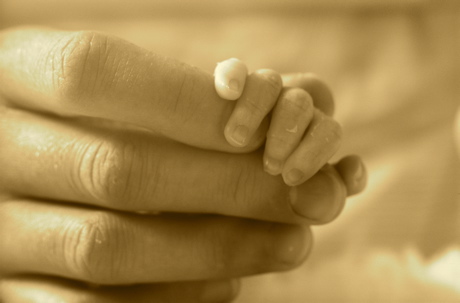
THOSE hands. So tiny, so small, so harmless. They were God’s hands. Yes, we could look at God’s hands, touch them, feel them… tender, warm, gentle. They were not a clenched fist, determined to bring justice. They were hands open, willing to grab whomever would hold them. The message was this:

Whoever loves me will keep my word, and my Father will love him, and we will come to him and make our dwelling with him.

THOSE hands. So strong, firm, but gentle. They were God’s hands. Extended in healing, raising the dead, opening the eyes of the blind, caressing the little children, comforting the sick and sorrowful. They were hands open, willing to grab whomever would hold them. The message was this:

I would leave ninety-nine sheep to find one little lost one.

THOSE hands. So bruised, pierced, and bleeding. They were God’s hands. Nailed by the lost sheep He sought, He did not raise them in a fist of punishment, but once again let His hands become… harmless. The message was this:

I did not come into the world to condemn the world, but that the world might be saved through Me.

THOSE hands. Powerful, firm, but gentle. They are God’s hands—open to receive all those who have kept His Word, who have let themselves be found by Him, who have believed in Him so that they might be saved. These are the hands which will at once extend to all of humanity at the end of time… but only a few will find them. The message is this:

Many are called, but few are chosen.

Yes, the greatest sorrow in hell will be the realization that the hands of God were as loving as a baby, gentle as a lamb, and as forgiving as a Father.

Truly, we have nothing to fear in these hands, except, to never be held by them.

Saturday, December 23, 2006