Harvey Trailer
One of my most FAVORITE movies.
Boy, I MISS Jimmy Stewart! Take a respite from your busyness and get a good CLEAN WHOLESOME laugh. Good medicine this!
Saturday, December 23, 2006

From the Vatican...
Jesus Offers the Only True Happiness, Says Pope
Warns That False Prophets Propose a "Cheap" Salvation
VATICAN CITY, DEC. 20, 2006 (Zenit.org).- Born in the poverty of Bethlehem, Jesus offers every man and woman true happiness, said Benedict XVI at the last general audience before Christmas.
At the audience, held today in Paul VI Hall amid a festive atmosphere that included Christmas carols, the Pope reflected on "the extraordinary event … that changed the course of history: the birth of the Redeemer."
In this context, the Holy Father asked: "Does humanity of our time still await the Savior?"
"The impression is that many think that God is foreign to their own interests," he told the 8,000 people on hand. "It would seem they have no need of him; they live as if he did not exist and, worse still, as if he were an 'obstacle' that must be removed so they can be fulfilled.
"However, despite its contradictions, anxieties and dramas, and perhaps because of them, today's humanity seeks a way of renewal, of salvation, a Savior and awaits, sometimes unconsciously, the coming of the Lord who renews the world and our lives; the coming of Christ, the only true Redeemer of man and of all men."
Benedict XVI said that "false prophets continue to propose a 'cheap' salvation, which always ends by causing harsh deceptions."
"In fact, the history of the last 50 years shows the search for a 'cheap' Savior and manifests all the disillusions that have derived from it," the Pope continued.
Expectations
"We Christians have the task to spread, with the testimony of life, the truth of Christmas, which Christ brings to all men and women of good will," he said. "On being born in the poverty of the stable, Jesus comes to offer to all the only joy and peace that can satisfy the expectations of the human spirit."
The Successor of the Apostle Peter invited the faithful to prepare for Christmas as Mary and Joseph did.
They "experienced in the first person the emotion and trepidation for the Child about to be born," the Holy Father said. "It is not difficult to imagine how they spent the last days, waiting to take the newborn in their arms.
"May the Child Jesus, being born among us, not find us distracted or dedicated simply to decorating our homes with lights. Rather, in our spirit and in our families let us decorate a worthy dwelling in which he feels welcomed with faith and love."
The Pontiff concluded by wishing all a holy and happy Christmas, "in particular those who are in difficulty or suffering in body and in spirit."
"Happy Christmas to you all!" he exclaimed.
ZE06122005
Perspective...
I borrowed this from your blog, Tiber Jumper. I hope you don't mind. This perspective needs to be seen by as many as possible. Thanks for posting it, TJ.

If this isn't perspective, I don't know what is. What about the astounding numbers at Omaha Beach within a few hours, too? The Civil War? I find it amazing that many opposed to being in Iraq, for whatever their reasons, be they: political, lust for power, hatred for President Bush, ad nauseum, these same people don't seem to have many qualms about wiping out 1/3 of the generation of my sons, ages 29 and 27. One third of their peers didn't get to see the light of day! What will we as a nation, and an electorate, have to say on that FINAL day, when we see the eyes of everyone of those aborted children looking at us? How will "freedom of choice" appear then?
Stone cold sobering isn't it?
susie
God have mercy.
JMJ
CHRIST Mass... how's that for politically incorrect?
what is Christmas about?
These kids got it right...Linus was able to speak about Jesus - during Christmas - on t.v. as children all over the world were watching... before the agonizing PC craziness. Yes, some of those children weren't Christian. Was it really such a grave offense? Was it really a worse world then? Doesn't it seem worse now that every one is so thin-skinned? This is CHRISTMAS not "winter solstice break." Imagine how Linus would have to speak now? Jesus Mary we love you, save the soul of America and the world. Amen. (Not Apeople...AMEN.)
God bless us everyone! May the the Child Jesus keep you all filled with wonder at His treasured gift, the gift of Himself, born a babe in a stable - the Savior of the world.
To all who visited our blog, may you have a Blessed Christmas and a joy-filled New Year.
susie & rich
JMJ
These kids got it right...Linus was able to speak about Jesus - during Christmas - on t.v. as children all over the world were watching... before the agonizing PC craziness. Yes, some of those children weren't Christian. Was it really such a grave offense? Was it really a worse world then? Doesn't it seem worse now that every one is so thin-skinned? This is CHRISTMAS not "winter solstice break." Imagine how Linus would have to speak now? Jesus Mary we love you, save the soul of America and the world. Amen. (Not Apeople...AMEN.)
God bless us everyone! May the the Child Jesus keep you all filled with wonder at His treasured gift, the gift of Himself, born a babe in a stable - the Savior of the world.
To all who visited our blog, may you have a Blessed Christmas and a joy-filled New Year.
susie & rich
JMJ
Saturday, December 16, 2006
Blessed Honoratus Kozminski

| Catholic saints are holy people and human people who lived extraordinary lives. Each saint the Church honors responded to God's invitation to use his or her unique gifts. God calls each one of us to be a saint. |  |  | |
| | | |
December 16, 2006
Blessed Honoratus Kozminski
(1825-1916)
 | |
| |
Honoratus served as guardian in a Warsaw friary already in 1860. He dedicated his energies to preaching, to giving spiritual direction and to hearing confessions. He worked tirelessly with the Secular Franciscan Order.
The failed 1864 revolt against Czar Alexander III led to the suppression of all religious Orders in Poland. The Capuchins were expelled from Warsaw and forced to live in Zakroczym, where Honoratus continued his ministry and began founding twenty-six male and female religious congregations, whose members took vows but wore no religious habit and did not live in community. They operated much as today’s secular institutes do. Seventeen of these groups still exist as religious congregations.
The writings of Father Honoratus are extensive: forty-two volumes of sermons, 21 volumes of letters as well as 52 printed works on ascetical theology, Marian devotion, historical writings, pastoral writings — not counting his many writings for the religious congregations he founded.
In 1906, various bishops sought the reorganization of these groups under their authority; Honoratus defended their independence but was removed from their direction in 1908. He promptly urged the members of these congregations to obey the Church’s decisions regarding their future.
He “always walked with God,” said a contemporary. In 1895 he was appointed Commissary General of the Capuchins in Poland. Three years before he had come to Nowe Miasto, where he died and was buried. He was beatified in 1988.Comment:
Quote:The story is told that Francis and Brother Leo, his secretary, were once on a journey and Francis volunteered to tell Leo what perfect joy is. Francis began by saying what it was not: news that the kings of France, England, as well as all the world’s bishops and many university professors had decided to become friars, news that the friars had received the gift of tongues and miracles, or news that the friars had converted all the non-Christians in the world. No, perfect joy for them would be to arrive cold and hungry at St. Mary of the Angels, Francis’ headquarters outside Assisi, and be mistaken by the porter for thieves and beaten by the same porter and driven back into the cold and rain. Francis said that if, for the love of God, he and Leo could endure such treatment without losing their patience and charity, that would be perfect joy (cited in Regis Armstrong, O.F.M. Cap., and Ignatius Brady, O.F.M., Francis and Clare: The Complete Works, pages 165-166).
Honoratus worked very zealously to serve the Church, partly by establishing a great variety of religious congregations adapted to the special circumstances of Poland in those years. He could have retreated into bitterness and self-pity when the direction of those congregations was taken away from him; that was certainly a “perfect joy” experience. He urged the members of these groups to obey willingly and gladly, placing their gifts at the service of the Good News of Jesus Christ.
When the Church removed Honoratus from the direction of his religious congregations and changed their character, he wrote: “Christ’s Vicar himself has revealed God’s will to us, and I carry out this order with greatest faith.... Remember, dear brothers and sisters, that you are being given the opportunity to show heroic obedience to the holy Church.”
And I've grumbled about when I can't find my car keys....or my back hurts...or I have a cold...or it's too hot...or it's too cold, or the sinks plugged up... ad nauseum. God, have mercy. Lord have mercy. Forgive me blessed Saviour. ~ susie
Friday, December 15, 2006
Thursday, December 14, 2006
Excerpt re: St. John of the Cross...

In the end, however, I may as well have the courtesy to admit one thing: St. John of the Cross is not everybody�s food. Even in a contemplative monastery there will be some who will never get along with him�and others who, though they think they know what he is about, would do better to let him alone. He upsets everyone who thinks that his doctrine is sup posed to lead one by a way that is exalted. On the contrary, his way is so humble that it ends up by being no way at all, for John of the Cross is unfriendly to systems and a bitter enemy of all exaltation. Omnis qui se exaltat humiliabitur. His glory is to do without glory for the love of Christ.
John of the Cross is the patron of those who have a vocation that is thought, by others, to be spectacular, but which, in reality, is lowly, difficult, and obscure. He is the patron and the protector and master of those whom God has led into the uninteresting wilderness of contemplative prayer. His domain is precisely defined. He is the patron of contemplatives in the strict sense, and of their spiritual directors, not of contemplatives in the juridical sense. He is the patron of those who pray in a certain way in which God wants them to pray, whether they happen to be in the cloister, the desert, or the city. There fore his influence is not limited to one order or to one kind of order. His teaching is not merely a matter of "Carmelite spirituality", as some seem to think. In fact, I would venture to say that he is the Father of all those whose prayer is an undefined isolation outside the boundary of "spirituality". He deals chiefly with those who, in one way or another, have been brought face to face with God in a way that methods cannot account for and books do not explain. He is in Christ the model and the maker of contemplatives wherever they may be found.
When this much has been said, enough has been said. St. John of the Cross was not famous in his own lifetime and will not be famous in our own. There is no need that either he, or contemplation, should be famous. In this world in which all good things are talked about and practically none of them are practised, it would be unwise to make contemplative prayer a matter for publicity, though perhaps no harm has been done, thus far, by making its name known. God himself knows well enough how to make the thing known to those who need it, in his designs for them.
Let it suffice to have said that this Spanish saint is one of the greatest and most hidden of the saints, that of all saints he is perhaps the greatest poet as well as the greatest contemplative, and that in his humility he was also most human, although I have not said much to prove it. I know that he will understand that this article about him was written as a veiled act of homage, as a gesture of love and gratitude, and as a disguised prayer. He knows what the prayer seeks. May he grant it to the writer and to the readers of these words.
Saints for Now, ed. Clare Booth Luce (Sheed & Ward 1952)
A letter to a dear friend...
My prayer this Advent season, (and asking St. John's fervent intercession for) is regarding this hope: That I'll decrease and Jesus will increase evermore in my heart, attitude and my whole being. He, St. John the Baptist, said "Behold the Lamb of God" The lamb of sacrifice in ancient days had to be male, without spot, blemish, and yes, had to be eaten. How full and overflowing is my gratitude now, to be brought back by His divine mercy and grace, to His Church, where I can finally "eat of the Lamb" who was sacrificed for the forgiveness of my sins at His altar, daily in the re-presentation of his sacrifice on Calvary. The Eucharist. A gift I never before knew the depth of...the true and Real Presence of Jesus! Now, to partake of this meal of the Lamb every day has made me "leap for joy" and set me free to see all things new, and to find Jesus in the face of those that I never even liked. I pray for them now rather than grumble and complain about them. Well, I 'try hard to do that' and sometimes fail, but that's what the blessed sacrament of Reconciliation is for, thank GOD! Transformed by Grace, given at this meal by the Victim Himself and offered by the High Priest, Jesus, is the only way we are free to "go and sin no more."
It's not that I didn't receive grace in other places when I repented, for I know I did. It was all part of this "Eucharistic Journey" so I have no deep regrets, since God used every step along the way to bring me back Home, to Rome. But it's like comparing McDonalds over and over again to a 7 course meal with an array of the most tantalizing desserts and the finest of wines at a most glorious "wedding feast" isn't it?
The messages (I heard over 26 years) preached were good. Some were very good. But they were only appetizers and the "opinions of men" that varied and even were diametrically opposed to another's opinion down the street. For some, that isn't a problem, but for me, it began to be, though at the time, I couldn't have articulated it like I'm able to do now, since I didn't think an actual return to the CC was anywhere close on my 'radar.' The messages and great music, in the end, did not satisfy the longing in my heart for the fullness of Truth - True food/True drink...His Flesh given for the Life of the world. Jesus didn't say "this is a symbol of my flesh, given for the life of the world." The difference is very stark, and incredibly sobering to me now. Why was I deaf to that years ago? I can't say. Why were my ears opened and my eyes opened two years ago? I can't say. Only by Grace. It's a mystery. I will hopefully allow deeper conversion to take place in me daily, and by that same Grace, to one day attain heaven and finally be enraptured by the Face of Love gazing down on me, humbled before Love forever, with Our Lady and the Saints.
Peace of Christ,
susie
Today I ask St. John the Baptist, and St Mary Magdalene to pray for me, to the Lord our God. To our Father, that this prodigal daughter never again will stray.
What John the Baptist Teaches us about...

Humility and Joy

On the third Sunday of Advent, the penitential purple of the season changes to pink and we celebrate “Gaudete” or “Rejoice!” Sunday. “Shout for joy, daughter of Sion” says Zephaniah. “Draw water joyfully from the font of salvation,” says Isaiah. “Rejoice in the Lord always,” says
Wait a minute. What’s that stark, strident saint of the desert doing here, on “Rejoice Sunday”? His stern call to repentance does not seem to fit.
Believe it or not,
Now this is very interesting. Crowds were coming to hear John from all over
Most of us would not appreciate the competition. The Pharisees and Sadducees certainly didn’t. They felt threatened by Jesus popularity. But John actually encouraged his disciples to leave him for Jesus, the Lamb of God. When people came, ready to honor John as the messiah, he set them straight. He was not the star of the show, only best supporting actor. John may have been center-stage for a while, but now that the star had shown up, he knew it was time for him to slip quietly off to the dressing room.

Or to use John’s own example, he was like the best man at a wedding. It certainly is an honor to be chosen as “best man.” But the best man does not get the bride. According to Jewish custom, the best man’s role was to bring the bride to the bridegroom, and then make a tactful exit. And John found joy in this. “My joy is now full. He must increase and I must decrease.”
The Baptist was joyful because he was humble. In fact, he shows us the true nature of this virtue. Humility is not beating up on yourself, denying that you have any gifts, talents, or importance. John knew he had an important role which he played aggressively, with authority and confidence. The humble man does not sheepishly look down on himself. Actually, he does not look at himself at all. He looks away from himself to the Lord.
Most human beings at one time or another battle a nagging sense inadequacy. Pride is sin’s approach to dealing with this. Proud people are preoccupied with self, seeing all others as competitors. The proud have to perpetually exalt themselves over others in hopes that this will provide a sense of worth and inner peace. Of course, it doesn’t. Human history has proven that time and time again. Even the pagan Greek storytellers knew that hubris or pride was the root of tragedy. Pride always comes before the fall, as it did in the Garden of Eden.

Humility brings freedom from this frantic bondage. Trying at every turn to affirm, exalt, and protect oneself is an exhausting enterprise. Receiving one’s dignity and self-worth as a gift from God relieves us from this stressful burden. Freed from the blinding compulsion to dominate, we can recognize the presence of God and feel a sense of satisfaction when others recognize that God is God and honor him as such. We can even be free to recognize Godliness in someone else and rejoice when others notice and honor this person.
But what about John’s stark call to repent? How this be Good News? Because repentance is all about humility and humility is all about freedom. And freedom leads to inner peace and joy, joy in the presence of the Bridegroom.
Saturday, December 09, 2006
Saint Juan Diego

A Model of Humility
 "I give praise to you, Father, Lord of heaven and earth, for although you have hidden these things from the wise and the learned you have revealed them to the childlike. Yes, Father, such has been your gracious will." (Mt 11, 25-26)
In April of 1990 Juan Diego was declared Blessed by Pope John Paul II at the Vatican. The following month, in the Basilica of Our Lady of Guadalupe in Mexico City, during his second visit to the shrine, John Paul II performed the beatification ceremony.
On July 2002 he was canonized by the Church, during a ceremony celebrated by John Paul II, again in the Basilica of Guadalupe.
Who was this Juan Diego?
Most historians agree that Juan Diego was born in 1474 in the calpulli or ward of Tlayacac in Cuauhtitlan, which was established in 1168 by Nahua tribesmen and conquered by the Aztec lord Axayacatl in 1467; and was located 20 kilometers (14 miles) north of Tenochtitlan (now Mexico City).
His native name was Cuauhtlatoatzin, which could be translated as "One who talks like an eagle" or "eagle that talks".
The Nican Mopohua describes him as a 'macehualli' or "poor Indian", one who did not belong to any of the social categories of the Empire, as priests, warriors, merchants,...but not a slave; a member of the lowest and largest class in the Aztec Empire. When talking to Our Lady he calls himself "a nobody", and refers to it as the source of his lack of credibility before the Bishop.
He devoted himself to hard work in the fields and manufacturing mats. He owned a piece of land and a small house on it. He was happily married but had no children.
Between 1524 and 1525 he was converted and baptized, as well as his wife, receiving the Christian name of Juan Diego and her wife the name of Maria Lucia. He was baptized by a Franciscan priest, Fr Peter da Gand, one of the first Franciscan missionaries.
According to the first formal investigation by the Church about the events, the Informaciones Guadalupanas of 1666, Juan Diego seems to have been a very devoted, religious man, even before his conversion. He was a solitary, mystical character, prone to spells of silence and frequent penance and used to walk from his village to Tenochtitlan, 14 miles away, to receive instruction on the doctrine.
His wife Maria Lucia became sick and died in 1529. Juan Diego then moves to live with his uncle Juan Bernardino in Tolpetlac, which was closer (9 miles) to the church in Tlatelolco -Tenochtitlan.
He walked every Saturday and Sunday many miles to church, departing early morning, before dawn, to be on time for Mass and religious instruction classes. He walked on naked feet, as all the people of his class, the macehualli. Only the higher social classes of the Aztecs wore cactlis, or sandals, made with vegetal fibers or leather. He used to wear in those chilly mornings a coarse-woven cactus cloth as a mantle, a tilma or ayate made with fibers from the maguey cactus. Cotton was only used by the upper Aztec classes.
During one of this walks to Tenochtitlan, which used to take about three and a half hours between villages and mountains, the First apparition occurred (See The apparitions page), in a place that is now known as the "Capilla del Cerrito", where the Blessed Virgin Mary talked to him in his language, Nahuatl. She called him "Juanito, Juan Dieguito" , "the most humble of my sons", "my son the least", "my little dear".
He was 57 years old, certainly an old age in a time and place where the male life expectancy was barely above 40.
After the miracle of Guadalupe and with the Bishop's permission, Juan Diego moved to a room attached to the chapel that housed the sacred image, after having given his business and property to his uncle, spending the rest of his life as a hermit. There he cared for the church and the first pilgrims who came to pray to the Mother of Jesus, and propagating the account of the apparitions to his countrymen.
He died on May 30, 1548, at the age of 74.
Juan Diego deeply loved the Holy Eucharist, and by special permission of the Bishop he received Holy Communion three times a week, a highly unusual occurrence in those times.
Pope John Paul II praised Juan Diego for his simple faith nourished by catechesis and pictured him (who said to the Blessed Virgin Mary: "I am a nobody, I am a small rope, a tiny ladder, the tail end, a leaf") as a model of humility for all of us.
See also:
John Paul II during the Juan Diego canonization liturgy, in the Basilica of Guadalupe -1
John Paul II during the Juan Diego canonization liturgy, in the Basilica of Guadalupe - 2
Juan Diego Cuauhtlatoatzin - Short biographyWednesday, December 06, 2006
December 8... a glorious day...
 This coming Friday is a very important day for the Church and for Rich and me. It was on December 8, 2004 that we came back to the Catholic Church and went to Mass for the first time in 26 years without it being a wedding or a funeral, and with our hearts full of joy and our eager participation. I remember being like a little girl that night, full of joy, wonder, awe, happiness, and being in the SAFE arms of Holy Mother Church and our Holy Mother, Mary. I can only say that gratitude is overflowing from my heart now. I am looking forward to Mass this Friday and will probably well up with joy once again. Why we were blessed with the grace to return to Rome is beyond me. I am only so grateful that we were and that by the same loving grace and mercy, were responsive to the Holy Spirit's nudges and took the plunge, swam the Tiber to the safety of the Church Jesus himself founded. Can it get any better than this??!!
Novena in preparation for the feast of The Immaculate Conception
by The Marian Library/International Marian Research Institute
November 22, 2006 / The history of a dogma is of great importance in order to understand how the church arrives at the definition of a particular belief. In the case of the dogma of the Immaculate Conception, the historical development is especially significant because of lack of explicit scriptural evidence.Already from the third
 century on there was a strong conviction that Mary was without sin. The Mother of Jesus Christ was compared to the incorruptible wood of the ark of the covenant and therefore without stain, immaculate, innocent and integral. In the East, Mary was considered the All Holy One (Panhagia).
The difficulty with celebrating Mary’s conception was the certainty that every person is conceived with original sin as Romans 5:12 states:
As through one man sin entered the world, and through sin death,
so death passed to all men, in as much as all sinned.
Paschasius Radbertus (786 – 860), a pioneer in Marian Doctrine, approached the issue with the inquiry whether or not it was appropriate to celebrate the birthday of Mary? Usually, the church celebrates the death day of a saint commemorating his or her new life in heaven. By commemorating Mary’s birthday, the question arose again whether Mary was exempt from original sin.
Eadmer of Canterbury (1124) was the first theologian of the Immaculate Conception:
He is famous for “Potuit, voluit, facit”. He (God) could, he wanted, he did [create Mary free from original sin]!
Meditation:
We praise you, Mary, Virgin and mother. After the Savior himself, you alone are all holy, free from all stain of sin, gifted by God from the first instant of your conception with a unique holiness.
Sunday, December 03, 2006
Meeting tonight....
 Hope to see everyone tonight. 5:30 - 7:30 p.m. at the Holy Family Shrine. I-80 exit 432
Hot cider will be provided and some cookies. Come enjoy fellowship and meet others in love with the Church and our blessed Faith.
About Fr. Kevin Fete...
The reason I've posted about this holy man of God, is because I've been praying to him since his death in July when Dr. Ray wrote and told me he'd passed on Sunday,July 23, 2006. In a way, he's who I've called the "patron saint" of RECON. He's who I've prayed to about this apostolate and I know he and St. Therese, a doctor of the Church are quite a team in heaven now!
I began praying to him right away, as I felt such an affinity for him, on Monday, the 24th. That was the day we received the apologetics series Dr. Ray and he made early this year. I found that to be rather uncanny, because I'd not known what he looked like, and here he was...laughing on the back cover of the dvd. That's the first picture I saw of him, a big grin, and how I see him so often now. When I finally was able to watch him and hear him speak, I was in awe. I fell in love with him and his love for Truth and Our Lady touched me. His brilliant mind, gentle way, kind heart, firm and resolute belief and love for Sacred Tradition and Orthodoxy held me captive. I wrote Dr. Ray and told him that I'd love to "sit at his feet" but that I'd not jump in front of a Mack truck to get there just yet. But I can't wait to meet him someday. He was the parish priest at Little Flower parish in Canton, Ohio for 10 years, and as I commented on another site, I know he and St. Therese are both busy "spending their heaven doing good on earth." He and St Therese are my "dynamic duo" who I call on every day to help me, to pray for others, to pray for RECON and all who will come to our meetings to learn and grow in the Faith. I'm so grateful that Dr. Ray made the series with him, and that his memory can live on so vividly through that medium. Please visit Dr. Ray's website and find out how to get these dvd's for yourself and as a gift for others. It's a wonderful tool for evangelization, perhaps for older children, college age who are searching. It's a way that I'd love to share the Faith with others. Dr. Ray plays the "antagonist" nicely, and they both have a special sense of humor that is charming. You can tell they're good friends.
I love to "storm Heaven with Father Kevin." He's the best and he's only changed location. He is still bringing Christ to people and people to Christ. Forever a priest of our Lord. Thank you Fr. K. for being a friend to all and loving everyone you met with the love of God. Thank you for your intercession for RECON and being an inspiration to me walking the lake and praying the rosary the last few months with you has been so special a time. I can't wait until it's warm enough again to walk, pray with and talk to you there again. You're my "go to guy" in my "starting line up" of Saints. ~ susie
For my article on Catholic Exchange about Fr. Kevin and meeting his friend, Fr. Gerard, while on pilgrimage in Rome in May 2007, please click here.
I began praying to him right away, as I felt such an affinity for him, on Monday, the 24th. That was the day we received the apologetics series Dr. Ray and he made early this year. I found that to be rather uncanny, because I'd not known what he looked like, and here he was...laughing on the back cover of the dvd. That's the first picture I saw of him, a big grin, and how I see him so often now. When I finally was able to watch him and hear him speak, I was in awe. I fell in love with him and his love for Truth and Our Lady touched me. His brilliant mind, gentle way, kind heart, firm and resolute belief and love for Sacred Tradition and Orthodoxy held me captive. I wrote Dr. Ray and told him that I'd love to "sit at his feet" but that I'd not jump in front of a Mack truck to get there just yet. But I can't wait to meet him someday. He was the parish priest at Little Flower parish in Canton, Ohio for 10 years, and as I commented on another site, I know he and St. Therese are both busy "spending their heaven doing good on earth." He and St Therese are my "dynamic duo" who I call on every day to help me, to pray for others, to pray for RECON and all who will come to our meetings to learn and grow in the Faith. I'm so grateful that Dr. Ray made the series with him, and that his memory can live on so vividly through that medium. Please visit Dr. Ray's website and find out how to get these dvd's for yourself and as a gift for others. It's a wonderful tool for evangelization, perhaps for older children, college age who are searching. It's a way that I'd love to share the Faith with others. Dr. Ray plays the "antagonist" nicely, and they both have a special sense of humor that is charming. You can tell they're good friends.
I love to "storm Heaven with Father Kevin." He's the best and he's only changed location. He is still bringing Christ to people and people to Christ. Forever a priest of our Lord. Thank you Fr. K. for being a friend to all and loving everyone you met with the love of God. Thank you for your intercession for RECON and being an inspiration to me walking the lake and praying the rosary the last few months with you has been so special a time. I can't wait until it's warm enough again to walk, pray with and talk to you there again. You're my "go to guy" in my "starting line up" of Saints. ~ susie
For my article on Catholic Exchange about Fr. Kevin and meeting his friend, Fr. Gerard, while on pilgrimage in Rome in May 2007, please click here.
God rest your precious, faithful soul, Father Kevin...

LOCAL FEATURES |
| Friday, August 11, 2006 |
Parishioners and friends remember Father Fete |
By Joanne Malene NORTH CANTON — There’s a big hole in the heart of Little Flower Parish that will probably take some time to heal. The recent death of Father Kevin Fete has left many of his old friends and parishioners desolate and yet, at the same time, laughing as they told stories of Father Kevin about his spirituality, his humanity and his humor. David Schmidt, pastoral associate at Little Flower, first met Father Fete 28 years ago when the two of them were at what was then St. Gregory’s Seminary in Cincinnati. “He was a junior in the seminary when I was a freshman, but our friendship grew over the years,” Schmidt said. “We became stronger friends after the seminary. In many ways, he was the same person after he was ordained as he was before he was ordained. I used to joke that he had mellowed over the years, but through and through, he was genuine. When my wife and I started having kids our friendship really blossomed. He often said if he had not been called to celibacy he would have had a dozen kids. He really liked hanging out with the kids.” “Father Fete took a very active role in RCIA [Rite of Christian Initiation of Adults],” Schmidt noted. “He was a good pastor, but he was also a great teacher. People were hungry for truth and for knowledge of the faith and he gave it to them. He was brilliant and insightful and had a great sense of humor. He saw things other people couldn’t see. That made him a tremendous homilist. He would grab people with his humor and, once he had them, he would drive home the point.” Father Michael Mikstay, a Youngstown diocesan priest and an active duty U.S. Navy chaplain stationed at the Naval Air Station in Jacksonville, Fla., also got to know Father Fete in the seminary. “He was in his first year at St. Gregory’s and I was in my last year,” Father Mikstay said. “Except when I have been deployed overseas or on a ship, there weren’t even two or three weeks that we didn’t talk. I grew up in St. Paul’s Parish in Canton and he grew up at St. Joan of Arc so we had a lot in common. “I guess the biggest thing we shared was a love of the priesthood and we had a mutual support for each other and for our unique ministries,” he said. “We shared some of the same hobbies. We actually lived together in several rectories when I was home in the diocese. I have to say he was my closest and dearest priest friend.” Father Mikstay said that Father Fete had a dedication to teach what the Church teaches and a dedication to spreading the faith, not only to his parishioners but also to people with whom he crossed paths. But, he said, Father Fete’s sense of humor was a key part of who he was. “The man probably could have been a stand-up comic,” Father Mikstay said. “He was extremely witty, extremely imaginative and had a tremendous sense of humor. But I would say just as humorous as he was and with his ability to joke and tease, he was as deeply spiritual and caring and compassionate. The Diocese of Youngstown – and I personally – has lost a rich and wonderful benefit. I have suffered the personal loss of a once-in-a-lifetime friend, colleague, confidant, brother. I believed Kevin to be one of God’s great blessings in my life. I am a better man and priest for having known and lived with him during my lifetime.” Michele Schafer was director of religious education at Little Flower for six years before becoming director of Campus Ministry at Walsh University in 2004. “As our pastor and shepherd, he was most definitely a preacher of powerful and eloquent words and he was full of challenge,” Schafer said. “Now that I look back, I see that the way he lived his life, was the living proclamation of God working through him. “He took very seriously his vocational call to be a priest,” she said. “He displayed much patience with us and he had a really beautiful balance between his pastoral ministry as a priest and his very humaneness to be with the people of God. He was always very personable. Christ is always pictured with people, eating with them, bringing them together; Father Fete was like that. He would walk into a room and just bring people together. He really lifted people up and he showed that he believed in their dignity and that they were important.” Bill Melvin and his family converted to Catholicism because of the ministry of Father Fete. Melvin came from an evangelical background, working as a Bible study teacher at a fundamentalist church before meeting the priest. “We joined Little Flower about eight years ago and went through RCIA,” Melvin said. “We were drawn to the parish because of the orthodoxy of Father Fete and his incredible way of explaining the Catholic faith. We heard about Little Flower from friends who had started going there. And, I think there were three or four couples from my Bible study who came to the Catholic faith because of him. “You have to understand, that everything with Father Fete was to the ‘nth’ degree, whether it was in football or the Catholic faith,” Melvin said. “Everything with him was by the book. If the Church taught it, then that was it. He had an incredible gift for homilies and for making everything seem so real. The faith just came alive under him. “Father Fete had a way of making everybody feel important,” he continued. “No matter who they were, he cared about everyone – whether you were a janitor or a rocket scientist – it didn’t matter who you were. If he met you once, you were in his heart. “It was an honor to learn the Faith under him. His homilies were so wonderful. We have lost a cherished gift in someone who can explain the faith as he could. He was by far the most gifted human being I have ever met in my life. “Two things I would say personified Father Fete. First, he never said goodbye; he always said, ‘Be at peace.’ And, if you asked him how he was, he would always say, ‘by the grace of God, brother.’ We will sorely miss him.” Gloria Mitchell, a parishioner at North Canton St. Paul, first met Father Fete when he came to St. Paul’s. She said there are a number of things she will remember about him. “First, it would be his no-nonsense Catholicism,” she said. “There wasn’t any room to stretch the rules; I think my faith deepened from knowing him. He had a wonderful sense of humor. And, he was incredibly intelligent. He was so knowledgeable about a vast number of topics that I was always amazed. And, he was very adventurous. I think he inspired people to live their lives to the absolute max. “Father believed in abiding by the laws of the Church and he thought that was very important,” Mitchell continued. “I am a cradle Catholic and I think I learned more about the Church from him. You could ask him about anything. “He loved things big; he did things in a big way and he liked it that way. And, he had such a wonderful sense of humor. Have you heard about the socks? He always wore bright colored socks. It was a way to express himself with his black clothing, but he loved any wild or brightly colored socks. In his casket he had bright pink socks and during calling hours, his family wore bright colored socks. And that is how he would have liked it. I feel honored, especially for the past few years and the past couple of months, to have known him and been part of his life.” Mitchell was part of a group that traveled to Tanzania. She said that wherever they went, in all of the little churches, Father Fete would preach. “It all had to be translated, of course, but the people loved him. At his funeral, a letter was read from the people of Moshi, Tanzania and I could feel that the people were truly grieving with us from the other side of the world.” Michele Schafer noted that Father Fete was known to say, “Do not make the minimum requirement your maximum responsibility.” “He understood the preciousness of life in everything he did,” Schafer said. The people of God were definitely his passion. He proved that to the very end, in the way he died. He was a great witness to all of us as we now have to move forward without him.” |
Saturday, December 02, 2006
Have A Little Faith
I always think of Jesus singing this to me.... I'm "his girl" and he's only wanting me to have faith, a small mustard seed of faith in Him...trusting as a child. John Hiatt is a most gifted singer/songwriter. His music for the most part transports me to a good place. We were blessed to see John perform 4 times. I pray he comes Home to Truth. What an incredible talent and master craftsman of words. I think the way this video ends, with John looking up and toward the window with the light streaming in is, I hope, prophetic. For the Light of the World is calling us all to "Have a little Faith...in HIM."
Friday, December 01, 2006
My attempt at drawing St Therese...
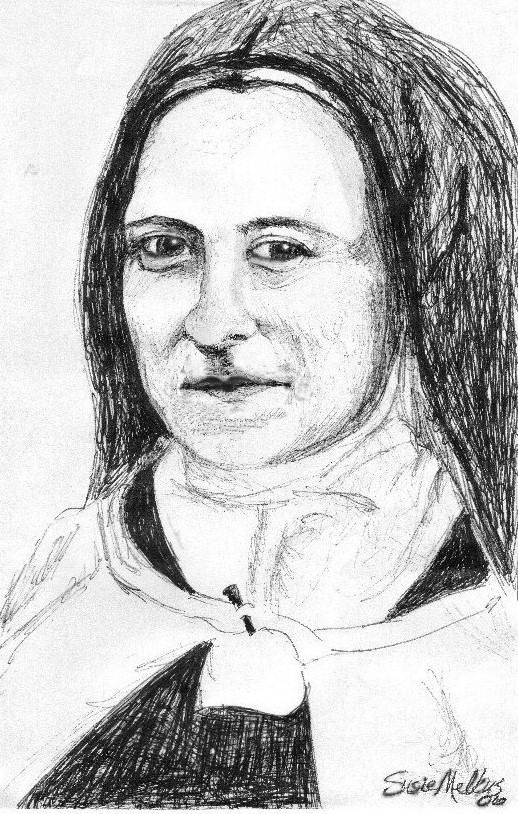
St Therese, teach me of your 'little way' and help me to become and stay a "child" in the eyes of my Lord so that he will hold me upon his lap and sing to me. To rest there, where I can sleep against his Sacred Heart, "snuggled up in a prayer." Thanks. susie
Tolkien...a hard hobbit to break...
Tolkien’s Catholic Imagination
By Jason Boffetti
Great books have much to fear from blockbuster movies. And Peter Jackson’s new film adaptation of The Lord of the Rings, set to be released in theaters next month, poses such a threat. Mesmerized by the cinematic eye-candy, the spin-off toys and games, and the fast-food tie-ins, fans who enter J.R.R. Tolkien’s world of Middle-earth for the first time through Jackson’s film might never bother to read Tolkien’s epic. Sadder still, they might never learn about the Catholic imagination that inspired it.
Even among fantasy devotees who recognize Tolkien as the father of the modern genre, few realize that Tolkien insisted that The Lord of the Rings is "a fundamentally religious and Catholic work." This probably comes as a surprise to most Catholics as well.
Readers of The Lord of the Rings are unlikely to find a "Catholic Middle-earth" by looking for overt references to the Christian gospel or hidden Catholic symbolism—Tolkien rejected this type of analysis—however they will find it by looking at Tolkien’s motivations as a writer.
Hobbies of an Oxford Don
To the outside world, Tolkien was the picture of the obscure Oxford don: bright, jovial, a bit on the chubby side, a fastidious dresser who alternated between sweaters and waistcoats beneath his Oxford tweed jackets. Although he was personable enough, students and other trespassers claimed they could barely understand a word he spoke because he mumbled everything through his omni-present pipe. In many ways, he was the very picture of the hobbits he wrote about, who preferred the comfort of home to grand adventures.
!Like many Oxford dons, he preferred a quiet academic life enriched by a peculiar hobby. Since his boyhood, Tolkien loved inventing imaginary languages and stories to go along with them. His penchant for language and myth drew Tolkien into an academic career. He became a professor of English literature at the University of Leeds and later at Oxford. But even as a full professor, he always found time to work on his "Elfin tongues."
The history of Middle-earth emerged from his fertile imagination as he created these fictitious languages. Throughout his life, Tolkien wrote, rewrote, and refined pivotal episodes of that history but was never fully satisfied with them. The distractions of life and the magnitude of the work kept him from completing his vision. These scattered writings—posthumously published by his son, Christopher, as The Silmarillion—form the narrative background of Middle-earth. Among the subplots is the saga of the One Ring—a ring that gives its possessor power to command Middle-earth’s darkest minions. The story of its creation and eventual destruction forms the basis for what are now regarded as his greatest works: The Hobbit and The Lord of the Rings..
When the first two volumes of The Lord of the Rings were released in 1954, 17 years after the great success of The Hobbit, Tolkien had been a professor at Oxford for 30 years and was just four years away from retirement. The renown that had previously eluded him hit like a firestorm in the 1960s, when his books were widely regarded as masterpieces, inspiring a new genre of literature: fantasy fiction. But popular success and the recognition of his peers were not the driving forces of his work. The driving force was always his Catholic faith.
A Mother’s Faith
Humphrey Carpenter, Tolkien’s authorized biographer, characterizes Tolkien’s devotion to the Catholic faith as "total." Friends knew him as a committed Catholic who was both openly apostolic (he was instrumental in the conversion of C.S. Lewis to Christianity) and privately pious.
!Throughout his life, Tolkien found the Eucharist an incomparable solace during the bouts of melancholy and despair he sometimes suffered. The special consolations he received at communion were especially important in the disorienting period when Vatican II was first implemented. He frequently went to confession, though sometimes his troubled self-reflection seemed to approach scrupulosity. When he could not bring himself to confess his sins, he would be racked by spiritual anxiety—devastated because he could not receive the Eucharist.
No one was more influential in the development of both his faith and intellect than his mother, Mabel. Tolkien maintained that everything he knew, he learned from his Catholic faith, and that he owed this faith to his mother, who, according to Tolkien, "clung to her conversion and died young, largely through the hardships of poverty resulting from it."
Mabel literally worked herself to death providing for her family after her husband died in South Africa from rheumatic fever when Tolkien was just four. She raised her two sons alone in a suburb of Birmingham, England. During these hardscrabble years, Mabel made two decisions that would shape the rest of the young Tolkien’s life: She raised her sons in the Catholic faith and made sure they had enough education to pursue university careers.
The first task was accomplished with the help of the priests at the Birmingham Oratory. Founded by John Henry Newman in 1859, the oratory had made the traditionally Presbyterian city of Birmingham into a center of Catholic resurgence in late 19th-century England. Mabel had grown up as a Unitarian and spent several years in the Anglican Church. After years of searching for the truth, she was received into the Catholic Church along with her boys at St. Anne’s Church in 1900.
Without a father’s income, however, the task of educating her sons would take some doing because the best schools charged tuition. Also, her decision to become Catholic estranged her from most of her family, who withdrew their financial support. So Mabel did what any resourceful woman with a fine middle-class education would do: She home-schooled her sons until they could pass the entrance exams and receive scholarships at a good private school.
Under Mabel’s instruction, Tolkien was reading by the age of four and learning Latin, French, and German by the age of seven. He took to languages with such precocious zeal that he was eventually accepted at one of the best private schools in England! on scholarship. In 1909 Tolkien’s academic career was secured when he was accepted to Exeter College at Oxford.
Unfortunately, Mabel did not live to see the fruits of her labor. In 1904, when Tolkien was just twelve, she died from diabetes, a disease that was then untreatable. Before she died, however, she ensured that her sons would continue to be raised Catholic by asking an Oratorian friend, Rev. Francis Morgan, to become their legal guardian—and by making her Protestant relatives promise they would not attempt to convert the boys.
Tolkien’s faith alone would have to sustain him in her absence. Until the two boys reached their majority, Father Morgan provided for them materially out of his personal resources. These were lean and hungry years for the brothers, but they always held a deep affection for the stern but sensitive Father Morgan. !While they were in his care, they never lacked for spiritual or intellectual support.
Father Morgan kept close tabs on his charges, who lived in a boarding house not far from the oratory. Each morning the boys assisted him at Mass and ate breakfast with him in the refectory.
Married Grace
Tolkien fell in love with a close friend, Edith Bratt, when he was just 16. Father Morgan discovered their clandestine love affair when he noticed Tolkien’s grades were slipping. Edith was three years older than Tolkien and a Protestant, so Father Morgan discouraged the relationship; eight years later, he would preside at their marriage.
Because of their different religious backgrounds, the marriage might have been a tragic disappointment, but the Tolkiens turned it into an occasion for grace. Although Edith had agreed to convert to Catholicism as a condition for marriage, she did so grudgingly. Over the years her resentment at having to go to confession grew steadily stronger—until finally she stopped attending Mass altogether and expressed disapproval when Tolkien took their children with him to church.
Since their religious differences proved irreconcilable, the Tolkiens agreed that Edith should begin attending Anglican services again. As a result, her hostility toward the faith of her children and husband disappeared. Despite their difficulties, their mutual devotion to family held their marriage together for 55 years, and they! were both delighted when their first son, John, became a Catholic priest.
Eucatastrophe and Mythopoeics
Of all his relationships, Tolkien’s friendship with C.S. Lewis was the most significant to his intellectual growth. These two men sharpened each other’s keen intellects during long walks in the English countryside. The fruits of this lifelong friendship are impossible to measure. Through convivial conversation, Tolkien discovered how he could integrate his Catholic faith with his literary vocation.
When Tolkien and Lewis first met as fresh young dons at Oxford in 1926, they were brought together by a shared love of Norse mythology. They gathered friends around the fire to read epic Norse poetry at their Coalbiter’s Club and later started an ad hoc literary society called the Inklings. The meetings of this small group of friends would inspire both Lewis’s Chronicles of Narnia and Tolkien’s Hobbit and Lord of the Rings.
It was their discussions about the relationship between literature and religion, however, that cemented Tolkien’s friendship with Lewis, a friendship that was at the center of Lewis’s conversion from agnosticism. Tolkien brought Lewis around to philosophical theism through patient persistence. His subsequent conversion to Christianity hinged on an argument Tolkien advanced that had special appeal to the myth-minded Lewis. That argument also reveals something important about Tolkien’s understanding of his vocation as an artist.
Tolkien noticed that it was common to all mankind throughout history to create mythologies in order to convey its most central beliefs. It is only reasonable to assume, he argued, that if there was a God, he would convey his revelation in the form of a myth, albeit a myth that was true. Christianity was the most likely candidate for the "perfect myth," since it shared all the great common elements of the best mythologies.
The gospel account was the "eucatastrophe," as Tolkien and Lewis came to call it, the happiest of all tragedies, because it satisfies the human heart’s deepest yearnings, including the desire for an epic mythology. But this myth had the added advantage of being historical fact, interpreted through a literary text and poetic tradition.
This insight unfolded for both Tolkien and Lewis an entire literary philosophy of mythopoeics (mythmaking), inspiring them to create new mythologies for our time. They would spend the rest of their lives arguing privately about how such an understanding of myth, religion, and literature could be applied to the art of writing.
For these two frustrated poets earning a living as Oxford dons, there was one obvious consequence of their theory of mythopoeics: They had to start writing! popular fiction. If God used narrative to communicate his revelation to man, and man is called to bear God’s image on earth, then one of the most noble vocations is to create new "secondary worlds" in narrative.
A Mythology for England
Although The Lord of the Rings and The Chronicles of Narnia represent the flowering of that agreement about mythopoeics, Tolkien and Lewis disagreed about their religious purposes, which explains why the literary styles they used to create Narnia and Middle-earth are so different.
Lewis, the evangelical Anglican, hoped his stories would bring the reader closer to the truth of the Christian Gospel. As a result, The Chronicles of Narnia bristles with obvious Christian symbolism, allegory, and moments of overt moral and religious instruction. In short, Lewis wanted his writing to be evangelistic.
For the Catholic Tolkien, however, it was more important that Middle-earth was successful as "sub-creation." Using his vast literary, linguistic, and historical talents, Tolkien created Middle-earth as an act of divine praise. The more convincing Middle-earth was as a real place, the purer that praise would be because it would more closely approach God’s own act of creation.
Unlike Lewis, Tolkien was unwilling to direct his fictive world according to any overt pedagogical design. He believed that the moment readers are made aware of any connections between our world and the "secondary world" of fiction, the literary spell is broken; readers reemerge from the imaginary world and realize that it is "just a story." Tolkien wanted them to believe that Middle-earth really exists and is not merely a tool for evangelism.
Few readers of The Lord of the Rings know that Tolkien hoped Middle-earth would become England’s native mythology. He thought that the Arthurian legends were weak compared with the Homeric epics and Norse legends. Middle-earth, with its inspirational heroics and warnings about the hazards of the will to power, was created to preserve a uniquely English cultural heritage from modernity’s infectious errors.
With this in mind, we can understand why Middle-earth seems to embrace magic and soft paganism. The historical framework for Tolkien’s imagination was England’s pre-Christian past—the scattered and disconnected Norse and Anglo-Saxon legends, with their tales of heroic valor and pagan mysticism. Tolkien purposely set Middle-earth before the advent of Christianity because he feared that it might otherwise lapse into a kind of enervated allegory.
Mining the Moral Geology
Despite this aversion to overt religiosity in his stories, Tolkien always affirmed that his work taught good morals and encouraged his readers! to turn to the Catholic faith. He simply refused to acknowledge that this should be the primary purpose of a mythmaker. Instead, Tolkien insisted that all successful "sub-creation" necessarily conveys moral truth, because the only good stories are those that accurately reflect the metaphysical world we live in and the moral choices we face.
So while Tolkien did not intend to preach Catholic moral theology, the moral tectonics of Middle-earth are distinctly Catholic. The evidence for Tolkien’s astonishing theological consistency and thoughtfulness can be found simply by reading at random from his published letters. There Tolkien admits that in creating Middle-earth he carefully constructed a world with the same moral contours as our world, a world created by a god with the same nature as our Creator.
!rd For example, Tolkien carefully avoids painting the struggle between the Free Peoples of Middle-earth and the minions of the arch-villain Sauron as strictly a battle of "good versus evil." Tolkien’s approach is thoroughly Augustinian: The characters of Middle-earth are distinguished above all by what they love, not where they live. In the fortress-cities of the Free Peoples, Minas Tirith and Edoras, one finds both the noble and the corrupt. Every character can be ruined by pride, and even the most wicked have the capacity for redemption.
Tolkien describes this tension most acutely in the character of Gollum, an obsequious and malevolent seeker of the One Ring, who is torn between a lust to possess the ring and his loyalty to the hobbits. Tolkien carefully portrays Gollum as both a treacherous murderer and a sympathetic victim of his own savagely !bent will. Even Sauron, Middle-earth’s Satan, was once a powerful angel-guardian before being corrupted by his evil desires.
Tolkien’s heroes have their faults as well, and we witness their moral tests. The wizard Gandalf and the great Southern prince, Boromir, are sorely tempted by the promise of glory through the power of the One Ring. And the hobbits must struggle with their desire to lay aside suffering and return to the comforts of their homeland, the Shire, rather than deliver the ring to its destruction in the Crack of Mount Doom.
In line with St. Thomas Aquinas’s teaching in his Summa Contra Gentiles, Tolkien never falls into the trap of describing a character or object as inherently good or evil. Evil, after all, is an absence— the absence of good—and therefore cannot be embodied by a person or thing.
Even the One Ring, forged by the magical art of Sauron, is never actually characterized as evil in itself. Rather, its power to command the Ringwraiths and the invisibility it confers are regarded as temptations that make the ring too dangerous for it to be used appropriately. The hobbits resist its strongest temptation to mortal sin only because they seem to lack any capacity for vainglory, but they are eventually worn down, physically and spiritually, by the venial sins it inspires.
Throughout the novels, Middle-earth’s ethics and metaphysics are consistent with the moral world we know: Corruption of the will, not magical power or fate, lies at the heart of evil acts. Magical objects—like technology in our own world—are good insofar as they are used for good ends. A willingness to share in suffering is a necessary part of taking up our moral duties.
But does the appearance of Catholic morality make Middle-earth Catholic or merely moralistic? For the distinctly Catholic components, we have to look slightly deeper.
Catholic ‘Accidents’
Tolkien rejected attempts to find Catholic symbolism in his work because he detested "allegory in all its manifestations." Indeed he frequently chided Lewis for trying to dress Christ up in the lion-suit of Aslan in The Lion, the Witch and the Wardrobe. For Tolkien, to look for such correspondences is to miss the point of Middle-earth, which is meant to be a real place and not just some amalgam of historical and religious debris.
Still, Tolkien acknowledged that his Catholic sensibilities unconsciously inspired characters and objects in his imaginative world. In a 1952 letter to Rev. Robert Murray (grandson of the founder of the Oxford English Dictionary and a family friend), he readily admitted that the Virgin Mary forms the basis for all of his "small perception of beauty both in majesty and simplicity." It is not surprising, he admits, that the character of Galadriel—a created being endowed with radiant beauty, impeccable virtue, and powers of healing—resonates with the character of our Blessed Mother.
Nor could Tolkien deny that the Holy Eucharist appears in The Lord of the Rings as the waybread (lembas), given by the elves to the hobbits to eat on their journey. The lembas reinforces the hobbits’ wills and provides them with physical sustenance in the dark and barren lands on the way to Mount Doom. As the Church teaches, while the Eucharist still tastes and looks like bread and wine, our sensations shroud a deeper mystery: The Eucharist is truly Christ’s body and blood. So in The Lord of the Rings the Blessed Virgin Mary and the Eucharist appear shrouded in the mysterious elements of Middle-earth. The best way to understand this is to see such examples of Catholic symbolism as literary "accidents." To leave them out would have diminished the story; they are parts of Tolkien’s effort to make his world complete, true for all times and places.
As an author, Tolkien believed that his stories did in a limited and literary way what a priest does at the consecration: They present us with Christ and the entire story of creation and redemption through common elements of the world—in this case Middle-earth—which is shot through with the Truth of all Truths.
A Heavenly Tree
Perhaps no single work shines as much light on Tolkien’s artistic intentions as his little-known short story, "Leaf by Niggle." It is Tolkien’s most autobiographical work and provides us with a window into his soul. Niggle is a middle-aged man who has painted a picture of a tree in his spare time. What starts out as just a tiny picture of a single leaf grows into a painting of a tree and then of the surrounding countryside, filling an enormous canvas. Niggle fears he will not finish it before he must begin a long-dreaded train trip from which he will not return. Meanwhile, various distractions and obligations to family, friends, and neighbors leave him very little time to paint.
Sure enough, Niggle begins the journey with his painting unfinished. Before the train takes him to his final destination, it stops at a purgatorial way-station of dreary toil, and he cannot continue his journey until "Two Voices" pass judgment on his life. In the end, they allow Niggle to continue—not because he painted a beautiful tree (as Niggle expected), but because he gave! himself in service to the most distracting of all his neighbors, Parish (in whom some see C.S. Lewis).
Niggle’s train finally brings him to an enchanted land. At its center he finds a tree, the same tree he was painting in his studio. But the tree and the surrounding scenery are incomplete, and Niggle is left to finish painting them in. Once finished, Niggle sets off to explore the lands he has created.
This story provides us with a most important Catholic insight: Corporal acts of mercy are every bit as much our vocation as the professional lives we lead in service to God. But Tolkien also tells us something important about his—and our—heavenly aspirations: Our vocations are essential parts of our identities. Through them, we will continue to serve and worship God for eternity.
All Catholic readers of The Lord of the Rings share with one another a heavenly aspiration: Someday we hope to journey, like Tolkien himself, across the Middle-earth kingdoms of Gondor and Rohan and into the Shire. There we’ll find Tolkien in his hobbit-hole; he will have been busy in our absence. We’ll sit with him, drinking strong tea or smoking good tobacco, while we listen to him tell us the stories of Middle-earth that he never found the time to finish.
Jason Boffetti is a Ph.D. candidate in political philosophy at the Catholic University of America and a research associate in education at the Faith & Reason Institute.
Hobbitually speaking...

John Ronald Reuel Tolkien (1892-1973) was a professor at Oxford University and scholar specializing in Old and Middle English. He is best known for this books, The Hobbit (1937) and The Lord of the Rings (1954-55), set in the imaginary world of Middle-earth populated by humans, Elves, Dwarves, Trolls, Goblins and Hobbits.
Born in South Africa, Tolkien returned to England with his mother and younger brother at age four after his father died. He was brought up in the Catholic faith and remained a devout Catholic throughout his life. After Tolkien's mother died in 1904, he was raised by a Catholic priest. Already Tolkien had mastered Latin and Greek, was learning Gothic and Finnish, and was inventing languages of his own. He began his studies at Exeter College, Oxford in 1911, studying the Classics, Old English, Gothic, Welsh and Finnish. During his study of Old English, he came across this couplet in a poem:
Eala Earendel engla beorhtast
Ofer middangeard monnum sended
Hail Earendel brightest of angels,
Over Middle Earth sent to men.
"Middangeard" was the term for our world, which is located in the middle between hell below and heaven above. This word inspired some of Tolkien's early poetry about an imaginary ancient world.
Tolkien enlisted as a second lieutenant and married Edith Bratt, whom he had known since he was sixteen years old, in March of 1916 shortly before being sent to active duty on the Western Front. After four months in the trenches he was sent home ill, and suffered relapses during the next two years. During this time he worked on his stories, Book of Lost Tales and Silmarillion. His first son was born in 1917. By the time of the Armistice in 1918, Tolkien had been appointed as Assistant Lexicographer for the Oxford English Dictionary.
A year later Tolkien became an associate professor of English at the University of Leeds. In addition to teaching, he collaborated with E.V. Gordon on their edition of Sir Gawain and the Green Knight. Two more sons were born while Tolkien was at Leeds. Then he became Professor of Anglo-Saxon (Old English) at Oxford in 1925. Later from 1945 until his retirement in 1959, Tolkien was Professor of English Language and Literature at Oxford. His last child and only daughter was born in 1929. He wrote illustrated letters from Santa Claus to his children each year, later published as The Father Christmas Letters. During his time at Oxford, Tolkien became a member of the now famous writers' group, "The Inklings," including his close friend C.S. Lewis.
During the summer of 1928, when Tolkien was grading examination books, he found one with a blank page. "One of the candidates mercifully left one of the pages with no writing on it—which is possibly the best thing that can happen to an examiner—and I wrote on it 'In a hole in the ground lived a hobbit.' Names always generate a story in my mind and eventually I thought I should find out what hobbits were like." This search resulted in a story that he told to his children. A draft of the story won the approval of a publisher's ten-year old son, Rayner Unwin, and the final version of The Hobbit was published in 1936.
Tolkien's sequel to The Hobbit grew into the 16-year saga, The Lord of the Rings. Thanks to the support of the now adult Rayner Unwin, his father's publishing house accepted the project, assuming that it would probably not make a profit, and published it in three volumes during 1954 and 1955. Needless to say, they drastically underestimated the popular appeal of the trilogy, and to Tolkien's amazement he even became rather wealthy.
I am in fact a hobbit in all but size. I like gardens, trees, unmechanized farm lands, I smoke a pipe and like good, plain food—unrefrigerated—but I detest French cooking. I like—and even dare to wear in these dull days—ornamental waistcoats. I'm fond of mushrooms out of a field, have a very simple sense of humor (which even my most appreciative critics find tiresome). I go to bed late, and get up late when possible. --J.R.R. Tolkien
The Nativity...

The casting is exquisite! The music, rapturous. The cinematography transports you onto the rocky terrain, and "gets you wet" in the river! Awesome in the truest sense of the word.
In the end, when Mary speaks, or prays rather, Her Magnificat, her "Song" is where I teared up. I need to go again....and "pray it" as Kris said this a.m. on Spirit Morning show http://www.kvss.com. It is the most phenomenal movie of this genre I've EVER seen. Jesus of Nazareth was good- really good- for it's time, and was very moving w/out a doubt. However, THIS is powerful in the most subtle and yet overwhelmingly "humanly spiritual" way in it's simplicity and for the WHOLE family, even little kids. There were some 5, 6, 7 year olds there last night and there were no "antsy" movements from any of them that I could see or hear around me. The story is so well known to all of us, you might be tempted to think, "oh I've seen it" before. No, you haven't. Seeing Joseph portrayed so "real" (not wimpy, or dully!) and all of the cast so genuinely HUMAN was genius! Joseph finally gets his "due" in this film. Keisha who plays Mary is so serene, youthful, innocent, yet "pondering" and so "Mary." It was wonderful to be in on the sneak preview last night with the KVSS crew. Arch Bishop Curtiss absolutely loved it, as did Fr. Val Peter and Fr. Boes from Boy's Town, and other religious from the Arch diocese. It is a MUST MUST MUST SEE! If you don't see this movie during this Advent season/Christmas season you'll be missing something extraordinary. It can and will change you. God is IN this movie. There. NUFF SAID. GO SEE IT.
susie with both thumbs up,all my toes and my goblet of merlot, raised in a toast. BEST MOVIE of 2006... in my opinion.
Subscribe to:
Posts (Atom)


