For those of you in Omaha, NE. please see my post below... My favorite day of the year ...for the Divine Mercy Sunday schedule at St. Robert Bellarmine parish. Come and be blessed today by the Divine Mercy of our Lord and Savior, Jesus Christ. It is 5 hours of MERCY.
There is an ocean of mercy that we all can be bathed in today...and any time we need forgiveness throughout our lives. Mercy comes to us in our need...in our sin, Mercy is there...calling us to reconciliation with our God. Mary, the Mother of Mercy is calling her sons and daughters always. Listen for your Mother's call. Let her mantle drape over you as you nestle in its folds, and find mercy near her breast. She will lead you gently to her Son, Jesus...your Savior, at your last breath. Divine Mercy is for ALL~ so come, come to the Ocean of Mercy and be "drowned" in His Love for you. Let Mercy wash away all your sin, and be cleansed from within, to live and be free from sin's grip. He extends Mercy now. Today if you hear His Voice, don't let your heart be hard any longer. Soften your heart, run to His Mercy and drown in His love. The time for Mercy is NOW. There is a feast waiting for you at your local Catholic Church. RUN, don't walk!
Bless you all!
"For the sake of his sorrowful passion, have mercy on us and on the whole world."
Sunday, March 30, 2008

Trish Short's Divine Mercy Chaplet...
Trish Short is going to be at St Thomas More parish today, (48th and Grover, Omaha NE) for Divine Mercy Sunday. I had the pleasure of meeting her at our Catholic Radio station, KVSS, Friday. She spoke in the afteroon for our Care-a-Thon. She will be giving her talk today at 3:00and I hope many will come to hear her powerful witness to Divine Mercy. She was Assembly of God, and after two abortions, and finding Divine Mercy...she's now Catholic and in love with Christ's Church.
Come to St Thomas More, for celebration today, beginning at 12:30 exposition of the Blessed Sacrament, confession/reconciliation, and an afternoon of MERCY!

My favorite day of the year! ...

Divine Mercy Sunday
St. Robert Bellarmine, Sunday March 30th
Day of Grace Program
Sunday, March 30
St. Robert Bellarmine
120th and Pacific
2:00 p.m.-7:00 p.m.
Schedule
2:00 - Video welcome - Archbishop Elden Francis Curtiss
2:10 - Examination of Conscience
2:55 - Exposition of the Blessed Sacrament
3:00 - Chaplet of Divine Mercy
3:30 - Benediction with Eucharistic Procession
4:00 - Video – Mercy in Our Lives
5:15 - Family lead Rosary
6:00 - Special Divine Mercy Sunday Mass
Childcare Available. For more information call: 498-9871
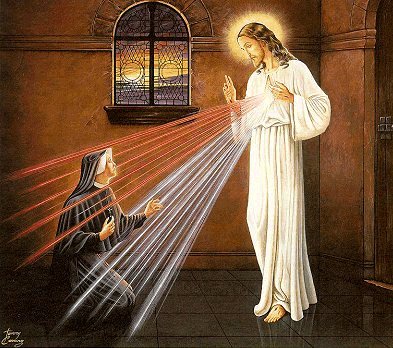
The Promise
According to St. Faustina, Our Lord promises to those who go to confession and communion on this day, the remission of the guilt and the punishment of sins.
On that day the very depths of My tender mercy are open. I pour out a whole ocean of graces upon those souls who approach the fount of My mercy. The soul that will go to Confession and receive Holy Communion shall obtain complete forgiveness of sins and punishment. On that day all the divine floodgates through which grace flow are opened. Let no soul fear to draw near to Me, even though its sins be as scarlet. My mercy is so great that no mind, be it of man or of angel, will be able to fathom it throughout all eternity. (Diary of Sr. Faustina, 699)
Many take this to mean that they must go to Confession ON Mercy Sunday. This is not true. To receive the benefits of the Promise one must be in the state of grace. The Lord does not promise the absolution of grave sin on Mercy Sunday, but points us to the Sacrament of Penance. To receive the grace we should be disposed. This is done by a confession near the time of Mercy Sunday. According to the Cardinal of Krakow, the confession which a Catholic makes during Lent in preparation for Easter is sufficient. Priests do not have to provide confession on Mercy Sunday so that Catholics can satisfy this condition. Since it is a Sunday the condition of Communion can be easily satisfied (including at the Saturday Vigil Mass). Our Communion, as our Confession, should be especially devout.
Some refer to this grace as a Plenary Indulgence. While the effect is the same, complete remission of sin and the punishment due to it, it is not granted by the Church but by a promise of the Lord. Also, the conditions are fewer, only Confession and Communion. While the Lord also asks for veneration of His Image on Mercy Sunday, as well as acts of mercy, these do not appear to be essential to the Promise, though they certainly could manifest the disposition, or lack of disposition, of the person seeking it. The receipt of the grace is not magic, but necessarily involves the opening of our hearts to mercy. This is best done by deeds, words and thoughts of mercy towards others. That, too, takes God's grace, but we can surely expect the actual graces to be mercifully available to us on Mercy Sunday, if we but trust. The message clearly states the Lord's willingness for the greatest generosity on this day. We do what our circumstances permit us, and trust in God. This is true also of those whose circumstances do not permit them to get to Communion on that day, such as the infirm and the home-bound. God does not ask the impossible.
The Image
I want the image solemnly blessed on the first Sunday after Easter, and I want it to be venerated publicly so that every soul may know about it. (Diary 341)
St. Robert Bellarmine, Sunday March 30th
Day of Grace Program
Sunday, March 30
St. Robert Bellarmine
120th and Pacific
2:00 p.m.-7:00 p.m.
Schedule
2:00 - Video welcome - Archbishop Elden Francis Curtiss
2:10 - Examination of Conscience
2:55 - Exposition of the Blessed Sacrament
3:00 - Chaplet of Divine Mercy
3:30 - Benediction with Eucharistic Procession
4:00 - Video – Mercy in Our Lives
5:15 - Family lead Rosary
6:00 - Special Divine Mercy Sunday Mass
Childcare Available. For more information call: 498-9871
The Promise
According to St. Faustina, Our Lord promises to those who go to confession and communion on this day, the remission of the guilt and the punishment of sins.
On that day the very depths of My tender mercy are open. I pour out a whole ocean of graces upon those souls who approach the fount of My mercy. The soul that will go to Confession and receive Holy Communion shall obtain complete forgiveness of sins and punishment. On that day all the divine floodgates through which grace flow are opened. Let no soul fear to draw near to Me, even though its sins be as scarlet. My mercy is so great that no mind, be it of man or of angel, will be able to fathom it throughout all eternity. (Diary of Sr. Faustina, 699)
Many take this to mean that they must go to Confession ON Mercy Sunday. This is not true. To receive the benefits of the Promise one must be in the state of grace. The Lord does not promise the absolution of grave sin on Mercy Sunday, but points us to the Sacrament of Penance. To receive the grace we should be disposed. This is done by a confession near the time of Mercy Sunday. According to the Cardinal of Krakow, the confession which a Catholic makes during Lent in preparation for Easter is sufficient. Priests do not have to provide confession on Mercy Sunday so that Catholics can satisfy this condition. Since it is a Sunday the condition of Communion can be easily satisfied (including at the Saturday Vigil Mass). Our Communion, as our Confession, should be especially devout.
Some refer to this grace as a Plenary Indulgence. While the effect is the same, complete remission of sin and the punishment due to it, it is not granted by the Church but by a promise of the Lord. Also, the conditions are fewer, only Confession and Communion. While the Lord also asks for veneration of His Image on Mercy Sunday, as well as acts of mercy, these do not appear to be essential to the Promise, though they certainly could manifest the disposition, or lack of disposition, of the person seeking it. The receipt of the grace is not magic, but necessarily involves the opening of our hearts to mercy. This is best done by deeds, words and thoughts of mercy towards others. That, too, takes God's grace, but we can surely expect the actual graces to be mercifully available to us on Mercy Sunday, if we but trust. The message clearly states the Lord's willingness for the greatest generosity on this day. We do what our circumstances permit us, and trust in God. This is true also of those whose circumstances do not permit them to get to Communion on that day, such as the infirm and the home-bound. God does not ask the impossible.
The Image
I want the image solemnly blessed on the first Sunday after Easter, and I want it to be venerated publicly so that every soul may know about it. (Diary 341)
Saturday, March 29, 2008
A very brave soul...
You probably won't read this in secular newspapers or hear it on the Today Show without a huge liberal bias with the veneer of relativism..."that's nice for Magdi, but this is only "his truth"....someone else's might be different blah blah blah." Well, I received this from Catholic Culture and had to post.
Meet Magdi Cristiano Allam...
May we all live our faith courageously as you and realize that being Catholic will mean being hated as Christ was hated. God bless you, Magdi, and welcome home.
Meet Magdi Cristiano Allam...
May we all live our faith courageously as you and realize that being Catholic will mean being hated as Christ was hated. God bless you, Magdi, and welcome home.
Sunday, March 23, 2008
We Follow Him...

We follow Him
With faith
To the unknown
With trust
To Gethsemane
With perseverance
To the cross
With hope
To our death
With confidence
To the tomb
With grace
To resurrection
With Mary and the Saints
To our Heavenly home
With Christ
To communion
With Love
Forever
susie melkus
03.23.08
Saturday, March 22, 2008
From our Archbishop, Shepherd and Teacher...
Archbishop Elden Francis Curtiss, as written in The Catholic Voice, Omaha, NE.

Celebrating Easter in faith: Rejoicing in what the Lord has done for us
Several years ago the novelist Morris West wrote and autobiographical article titled "A View from the Ridge." He said that once we reach a certain age of maturity, there should be only one phrase left in our vocabulary: "Thank you!"
For all of us who live in faith, Easter gives us the best reason in the world to say, "Thank you" to the Father of al light who has sent his Son into our world to be our light.
I am sure that the 800 adults and young people in our archdiocese who will either be baptized at the Easter Vigil or come into full communion with us (if already baptized), and will share the gifts of the Holy Spirit and feed on the body and blood of Jesus for the first time-- I am sure their hearts will be filled with gratitude when they reflect on the journey they have made because of the Lord's love for them and his guidance.
JESUS CONTINUES TO DRAW US TO THE CROSS
We have reflected this past week on the terrible price Jesus paid for us on the cross, so that we do not have to live in our sins. We are amazed that he loves us so much and that he will go to such lengths to win our love, not only by his sacrifice for us on Calvary, but by his constant effort to entice us to himself at the present time. He constantly reaches out to us, through his living Word in the Scripture and through the sacramental life of the Church, especially the Eucharist, and through the many people who touch our lives with his love and care. Jesus never ceases trying to make us aware of his presence and his desire that we should learn to respond, at least in some small degree, to his love for us.
How else can we explain all the adults and young people who are coming into the Church this Easter? Certainly none of us are capable of drawing these people by ourselves. Catholicism stands in marked contrast to the secular values of our world. The only reason so many people every year are willing to commit themselves to Jesus and to his Church is because of the force of his love that draws them. It is not just the cohesiveness of our teaching and its continuity from the first apostlesthat draws people to the Church. It is not just the fact that we are the largest Christian faith community in the world. People are drawn to the Church, drawn to the Eucharist, by a force beyond themselves. They sense the Lord drawing them to himself in the Church. They recognize that at the very heart of the Church's life is Jesus, present to us, loving us, healing us, constantly drawing us out of the darkness that always threatens to overshadow us.
CONTINUITY OF THE CHURCH THROUGH THE CENTURIES
Scott Hahn, the famous convert and Catholic apologist, remarked recently that if people in general had the opportunity to learn what the Catholic Church really teaches, and had the opportunity to explain that teaching in its development from the first century, most of them would end up embracing Catholicism. But we know there are many obstacles that prevent non-Catholics from taking a serious look at the Church and her teaching. Misinformation about the Church and distortions about her teaching and practices are everywhere in our society. Some of the opposition to the Church is well-intentioned and honest; some of it is dishonest and even diabolical. The Evil One does not want the Church to be strong and unified and influential.
At the same time, we know from experience and revelation that faith is ultimately a gift, a grace from God. It is one thing to examine all the reasons that we believe what we do, and to trace the essentials of our teaching back to the first apostles. But it is quite another thing to be able to say "I believe" when one is confronted with mystery--the Trinity, the incarnation of the Son of God, the Eucharist--all the truths of faith that cannot be understood by our minds alone. God reveals himself to us in his creation, in his prophets of old, and especially in his Son made man, in Jesus. Bu t it is only when a light goes on inside of us and we experience the reality of the truth that has been revealed to us--it is only when we experience the presence and love of the one revealing himself to us and his plan for us, only then does our fiaht come alive and we can cry out, "Yes I do believe, O Lord, help my disbelief!"
GRATITUDE SHOULD BE OUR RESPONSE TO JESUS
For those who will embrace the fullness of Catholic faith in our parishes this Easter weekend, and for the rest of us who have been on this faith journey for years, all of us should be filled with gratitude for what the Lord has done in our lives. Despite our weaknesses and our unworthiness, Jesus constantly draws us to himself by his teaching and his love. Despite the habits of sin in our lives and our own occasional lapses into tepidity and neglect, the Spirit stirs in us, especially at certain seasons of the year when we are vividly reminded of the Lord's love for us.
Our Lenten reflections this year, trying to focus on our journey home to the Father, and recalling the lengths to which Jesus was willing to go to show his love for us--this process helps us to prepare for the joy of Easter. He died for us, he is risen as he promised and he heps us on our way to the Father. This Easter, then should find us filled with gratitude to God for revealing himself to us and his plan for our salvation. And our hearts should be filled with gratitude that we have been gifted with faith so that we can experience his presence and love for us in so many ways, especially in his Eucharist.
Easter is a time for us to recall everything that God has done and is doing in our lives. Easter is a time for us to rejoice and give thanks for our Savior and for the Church he founded for us, and for the gift of faith that helps us to experience Jesus alive in our midst.
So, a very Blessed Easter to all in Northeastern Nebraska who understand what Easter really means to the family of God.
Several years ago the novelist Morris West wrote and autobiographical article titled "A View from the Ridge." He said that once we reach a certain age of maturity, there should be only one phrase left in our vocabulary: "Thank you!"
For all of us who live in faith, Easter gives us the best reason in the world to say, "Thank you" to the Father of al light who has sent his Son into our world to be our light.
I am sure that the 800 adults and young people in our archdiocese who will either be baptized at the Easter Vigil or come into full communion with us (if already baptized), and will share the gifts of the Holy Spirit and feed on the body and blood of Jesus for the first time-- I am sure their hearts will be filled with gratitude when they reflect on the journey they have made because of the Lord's love for them and his guidance.
JESUS CONTINUES TO DRAW US TO THE CROSS
We have reflected this past week on the terrible price Jesus paid for us on the cross, so that we do not have to live in our sins. We are amazed that he loves us so much and that he will go to such lengths to win our love, not only by his sacrifice for us on Calvary, but by his constant effort to entice us to himself at the present time. He constantly reaches out to us, through his living Word in the Scripture and through the sacramental life of the Church, especially the Eucharist, and through the many people who touch our lives with his love and care. Jesus never ceases trying to make us aware of his presence and his desire that we should learn to respond, at least in some small degree, to his love for us.
How else can we explain all the adults and young people who are coming into the Church this Easter? Certainly none of us are capable of drawing these people by ourselves. Catholicism stands in marked contrast to the secular values of our world. The only reason so many people every year are willing to commit themselves to Jesus and to his Church is because of the force of his love that draws them. It is not just the cohesiveness of our teaching and its continuity from the first apostlesthat draws people to the Church. It is not just the fact that we are the largest Christian faith community in the world. People are drawn to the Church, drawn to the Eucharist, by a force beyond themselves. They sense the Lord drawing them to himself in the Church. They recognize that at the very heart of the Church's life is Jesus, present to us, loving us, healing us, constantly drawing us out of the darkness that always threatens to overshadow us.
CONTINUITY OF THE CHURCH THROUGH THE CENTURIES
Scott Hahn, the famous convert and Catholic apologist, remarked recently that if people in general had the opportunity to learn what the Catholic Church really teaches, and had the opportunity to explain that teaching in its development from the first century, most of them would end up embracing Catholicism. But we know there are many obstacles that prevent non-Catholics from taking a serious look at the Church and her teaching. Misinformation about the Church and distortions about her teaching and practices are everywhere in our society. Some of the opposition to the Church is well-intentioned and honest; some of it is dishonest and even diabolical. The Evil One does not want the Church to be strong and unified and influential.
At the same time, we know from experience and revelation that faith is ultimately a gift, a grace from God. It is one thing to examine all the reasons that we believe what we do, and to trace the essentials of our teaching back to the first apostles. But it is quite another thing to be able to say "I believe" when one is confronted with mystery--the Trinity, the incarnation of the Son of God, the Eucharist--all the truths of faith that cannot be understood by our minds alone. God reveals himself to us in his creation, in his prophets of old, and especially in his Son made man, in Jesus. Bu t it is only when a light goes on inside of us and we experience the reality of the truth that has been revealed to us--it is only when we experience the presence and love of the one revealing himself to us and his plan for us, only then does our fiaht come alive and we can cry out, "Yes I do believe, O Lord, help my disbelief!"
GRATITUDE SHOULD BE OUR RESPONSE TO JESUS
For those who will embrace the fullness of Catholic faith in our parishes this Easter weekend, and for the rest of us who have been on this faith journey for years, all of us should be filled with gratitude for what the Lord has done in our lives. Despite our weaknesses and our unworthiness, Jesus constantly draws us to himself by his teaching and his love. Despite the habits of sin in our lives and our own occasional lapses into tepidity and neglect, the Spirit stirs in us, especially at certain seasons of the year when we are vividly reminded of the Lord's love for us.
Our Lenten reflections this year, trying to focus on our journey home to the Father, and recalling the lengths to which Jesus was willing to go to show his love for us--this process helps us to prepare for the joy of Easter. He died for us, he is risen as he promised and he heps us on our way to the Father. This Easter, then should find us filled with gratitude to God for revealing himself to us and his plan for our salvation. And our hearts should be filled with gratitude that we have been gifted with faith so that we can experience his presence and love for us in so many ways, especially in his Eucharist.
Easter is a time for us to recall everything that God has done and is doing in our lives. Easter is a time for us to rejoice and give thanks for our Savior and for the Church he founded for us, and for the gift of faith that helps us to experience Jesus alive in our midst.
So, a very Blessed Easter to all in Northeastern Nebraska who understand what Easter really means to the family of God.
~ A VERY HAPPY AND BLESSED EASTER
TO ALL MY BLOGGER FRIENDS
AND YOUR FAMILIES ~
Jesus remember me, when you come into your Kingdom
OUR HOPE IS ALIVE!
JESUS IS RISEN!
TELL ALL THE GOOD NEWS!
susie
TO ALL MY BLOGGER FRIENDS
AND YOUR FAMILIES ~
Jesus remember me, when you come into your Kingdom
OUR HOPE IS ALIVE!
JESUS IS RISEN!
TELL ALL THE GOOD NEWS!
susie
Tuesday, March 18, 2008
And "What does holiness consist of, Papa?" and he said...
Pope Benedict XVI

"The saints are not people who never made mistakes or sinned, but who repented and were reconciled. Hence, also among saints there are oppositions, discords and controversies, and this is very consoling for me, as we see that the saints have not 'fallen from heaven. They are men like us, with complicated problems. Holiness does not consist in not making mistakes or never sinning. Holiness grows with the capacity for conversion, repentance, willingness to begin again, and above all with the capacity for reconciliation and forgiveness. And we can all learn this way of holiness."
I just read about St Margaret Mary before Lent...
 SAINT MARGARET MARY ALACOQUE
Virgin, Apostle of the Sacred Heart (1647-1690)
Spiritual Bouguet: Bear one another's burdens, and so you will fulfill the law of Christ (Gal. 6:2).
Saint Margaret Mary, a soul of divine predilection, was born at Terreau in Burgundy, on July 22, 1647. During her infancy she showed a wonderfully sensitive revulsion to the very idea of sin, and while still a young child always recited the entire Rosary every day. She lost her father at the age of eight years, and her mother placed her with the Poor Clares. She was often sick and for four years was bedridden, losing almost entirely the use of her members. She made a vow to Our Lady to become one of Her daughters if She cured her, and was suddenly entirely well. She was of a gay temperament and her heart became easily attached to human affections. God began her purification when the charge of her mother’s house was confided to persons who reduced the family to a sort of servitude. Margaret Mary turned to God for strength and consolation when she was accused of various crimes she had not committed. In short, the Saint of the Sacred Heart learned to suffer for Christ, with patience, what innocence can suffer in such situations. She desired to be a religious, but her mother could not bear to hear a word of that desire. Finally God came to her assistance through a Franciscan priest, who told her brother that he would answer to God for the vocation of his sister. In 1671 she entered the Order of the Visitation of Mary, at Paray-le-Monial, and was professed the following year. She followed all the practices of the monastery in perfect obedience, spending as much time as she could in the chapel with her Lord. After sanctifying her by many trials, Jesus appeared to her in numerous visions, displaying to her His Sacred Heart, sometimes burning as a furnace, and sometimes torn and bleeding on account of the coldness and sins of men. “Behold this Heart which has so loved men, and been so little loved by them in return!”
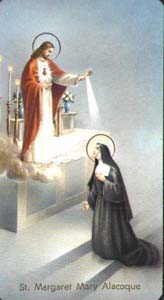 In 1675, she was told by Our Lord that she, with the aid of Father Claude de la Colombiere of the Society of Jesus, was to be His instrument for instituting the feast of the Sacred Heart, and for spreading that devotion everywhere. This was not accomplished without great sufferings. The good Jesuit did all in his power to make known and loved the Heart of Jesus, but when it seemed all obstacles were about to disappear, his credit diminished, and his Superiors sent him to England. He returned to France exhausted and soon died. Saint Margaret Mary was for a time Mistress of Novices, and in this office exercised a true apostolate, working to win for the Heart of Jesus the hearts of the young girls who were aspiring to religious consecration. She was persecuted when she sent one of them home, not having seen in her the indications of a genuine vocation; the family attempted to have her deposed. She remained in the charge but was deprived of Holy Communion on the First Friday of the month. This practice was one of Our Lord’s specific requests; for souls who communicate nine First Fridays in succession, He promised the most wonderful graces. The demons also persecuted her visibly; nonetheless her entire Community was finally won over to devotion to the Divine Heart.
Saint Margaret Mary died at the age of forty-two years, on October 17, 1690, and everywhere was heard in the city: “The Saint is dead! The Saint is dead!” She was beatified in 1864 by Pope Pius IX, and canonized in 1920 by Pope Benedict XV.
Reflection: Love for the Sacred Heart especially honors the Incarnation, and makes the soul grow rapidly in humility, generosity, patience, and union with its Beloved.
Sources: Little Pictorial Lives of the Saints, a compilation based on Butler’s Lives of the Saints and other sources by John Gilmary Shea (Benziger Brothers: New York, 1894); Les Petits Bollandistes: Vies des Saints, by Msgr. Paul Guérin (Bloud et Barral: Paris, 1882), Vol. 12.
after www.magnificat.ca
Monday, March 17, 2008
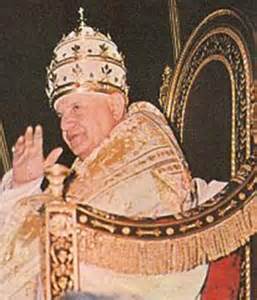
The Daily Decalogue of Blessed John XXIII ...
1. Only for today, I will seek to live the livelong day positively without wishing to solve the problems of my life all at once.
2. Only for today, I will take the greatest care of my appearance; I will dress modestly; I will not raise my voice; I will be courteous in my behavior; I will not criticize anyone; I will not claim to improve or to disciple anyone except myself.
3. Only for today, I will be happy in the certainty that I was created to be happy, not only in the other world, but also in this one.
4 Only for today, I will adapt to circumstances, without requiring all circumstances to be adapted to my own wishes.
5. Only for today, I will devote ten minutes of my time to some good reading, remembering that just as food is necessary to the life of the body, so good reading in necessary to the life of the soul.
6. Only for today, I will do one good deed and not tell anyone about it.
7. Only for today, I will do at least one thing I do not like doing; and if my feeling are hurt, I will make sure that no one notices.
8. Only for today, I will make a plan for myself; i may not follow it to the letter, but I will make it. And I will be on guard against two evils: hastiness and indecision.
9. Only for today, I will firmly believe, despite appearances, that the good Providence of God cares for me as not else who exists in this world.
10. Only for today, I will have no fears. In particular, I will not be afraid to enjoy what is beautiful and to believe in goodness. Indeed, for twelve hours I can certainly do what might cause me consternation were I to believe I had to do it all my life.
Thank you for your wisdom and your love.
Pray for us, Papa.
2. Only for today, I will take the greatest care of my appearance; I will dress modestly; I will not raise my voice; I will be courteous in my behavior; I will not criticize anyone; I will not claim to improve or to disciple anyone except myself.
3. Only for today, I will be happy in the certainty that I was created to be happy, not only in the other world, but also in this one.
4 Only for today, I will adapt to circumstances, without requiring all circumstances to be adapted to my own wishes.
5. Only for today, I will devote ten minutes of my time to some good reading, remembering that just as food is necessary to the life of the body, so good reading in necessary to the life of the soul.
6. Only for today, I will do one good deed and not tell anyone about it.
7. Only for today, I will do at least one thing I do not like doing; and if my feeling are hurt, I will make sure that no one notices.
8. Only for today, I will make a plan for myself; i may not follow it to the letter, but I will make it. And I will be on guard against two evils: hastiness and indecision.
9. Only for today, I will firmly believe, despite appearances, that the good Providence of God cares for me as not else who exists in this world.
10. Only for today, I will have no fears. In particular, I will not be afraid to enjoy what is beautiful and to believe in goodness. Indeed, for twelve hours I can certainly do what might cause me consternation were I to believe I had to do it all my life.
Thank you for your wisdom and your love.
Pray for us, Papa.
Thursday, March 13, 2008
Mary Mother of God.... pray for us!
Please pray for us, for all your children, from far and wide, near the Tiber, across the Tiber, far away from the Tiber in the farthest of places. We pray for unity, and for peace among all brethren. Thank you, Our Lady, Queen of Peace, and our dearest, MOTHER OF GOD.

Wedding Feast Of Cana Jn 21-11Jn 21:21; Jn 4:46-54
1 On the third day there was a wedding in Cana in Galilee, and the mother of Jesus was there.
2 Jesus and his disciples were also invited to the wedding.
3 When the wine ran short, the mother of Jesus said to him, "They have no wine."
4 (And) Jesus said to her, "Woman, how does your concern affect me? My hour has not yet come."
5 His mother said to the servers, "Do whatever he tells you."
6 Now there were six stone water jars there for Jewish ceremonial washings, each holding twenty to thirty gallons.
7 Jesus told them, "Fill the jars with water." So they filled them to the brim.
8 Then he told them, "Draw some out now and take it to the headwaiter." So they took it.
9 And when the headwaiter tasted the water that had become wine, without knowing where it came from (although the servers who had drawn the water knew), the headwaiter called the bridegroom
10 and said to him, "Everyone serves good wine first, and then when people have drunk freely, an inferior one; but you have kept the good wine until now." John 2:1-10.
Now, here are the same verses with the symbolic types and word-pictures high-lited...
1 On the third day there was a wedding in Cana in Galilee, and the mother of Jesus was there.
2 Jesus and his disciples were also invited to the wedding.
3 When the wine ran short, the mother of Jesus said to him, "They have no wine."
4 (And) Jesus said to her, "Woman, how does your concern affect me? My hour has not yet come."
5 His mother said to the servers, "Do whatever he tells you."
6 Now there were six stone water jars there for Jewish ceremonial washings, each holding twenty to thirty gallons.
7 Jesus told them, "Fill the jars with water." So they filled them to the brim.
8 Then he told them, "Draw some out now and take it to the headwaiter." So they took it.
9 And when the headwaiter tasted the water that had become wine, without knowing where it came from (although the servers who had drawn the water knew), the headwaiter called the bridegroom
10 and said to him, "Everyone serves good wine first, and then when people have drunk freely, an inferior one; but you have kept the good wine until now."
First, Christ's resurrection happened on the "third" day because the Three Type = "the will of God," and it was the will of God that Christ be raised. Note well that this wedding feast is occurring on a "third day" -- resurrection day!
Next, we have a "wedding." In the Old and New Testaments, the "wedding" word-picture is used to celebrate the "wedding" of Christ to His Church.
So, the events here are occurring in the course of the "wedding" of resurrected Christ to His Church.
Now, in the Bible, "wine" = "the saving blood of Christ." So, when we are told that the "wine" has "run short," we are being told typologically (or "allegorically" -- the difference is not critical, here) that, "Hey, man, help from the resurrected Savior and saving grace, purchased by His blood, is needed!"
Now, note the precise structure of events in this story...
(1) Mary goes to Jesus -- "They need some wine" -- "saving blood, and the saving grace purchased by that saving blood."
(2) Functionally, Jesus responds coldly, "Leave me alone. This is none of your business. It's not time."
(3) Mary, anyway, with confidence, tells the waiters to do what He says.
(4) Jesus, in spite of His cold rebuke of Mary, goes ahead and does what she asks, anyway!
A common answer by our Protestant brothers to Marian theology is, "God doesn't need her help!"
True! Very, very true!
However, in this story, we see a picture of Mary being allowed to "butt-in" on the salvation process, even though it is against God's timing!
Now, let's analyze the process itself in the story.
First, the "jars" here are made of "stone." This is an analog of -- a "synonym of" or "version of" -- the Rock Type meaning "church."
There are "six" in number. Six = the Six Type = "evil." So, these six stone jars symbolize evil people in the Church. This conforms to Mary's statement that they need "wine" -- these sinners in the Church need some of the salvation purchased by Jesus' saving blood.
Jesus has the waiters fill them with potable water -- an analog of the River Type for "salvation." The water is miraculously turned to wine -- a picture of salvation activated by the saving blood of Christ, generated for sinners in the Church at interceding Mary's request!
Manager, MARYMOTHEROFGOD 930611
WELCOME TO OUR COMMUNITY OF:
As the Ecumenical Council of Ephesus declared in A.D. 431, "Mary is truly 'Mother of God' since she is the mother of the eternal Son of God made man, who is God himself" (CCC 495). "In fact, the One whom the conceived as man by the Holy spirit, who truly became her Son according to the flesh, was none other than the Father's eternal Son, the second person of the Holy Trinity. Hence the Church confesses that Mary is truly 'Motherof God' (theo-tokos)" (CCC 507)
PaulaJeane, Assistant Manager
Wedding Feast Of Cana Jn 21-11Jn 21:21; Jn 4:46-54
1 On the third day there was a wedding in Cana in Galilee, and the mother of Jesus was there.
2 Jesus and his disciples were also invited to the wedding.
3 When the wine ran short, the mother of Jesus said to him, "They have no wine."
4 (And) Jesus said to her, "Woman, how does your concern affect me? My hour has not yet come."
5 His mother said to the servers, "Do whatever he tells you."
6 Now there were six stone water jars there for Jewish ceremonial washings, each holding twenty to thirty gallons.
7 Jesus told them, "Fill the jars with water." So they filled them to the brim.
8 Then he told them, "Draw some out now and take it to the headwaiter." So they took it.
9 And when the headwaiter tasted the water that had become wine, without knowing where it came from (although the servers who had drawn the water knew), the headwaiter called the bridegroom
10 and said to him, "Everyone serves good wine first, and then when people have drunk freely, an inferior one; but you have kept the good wine until now." John 2:1-10.
Now, here are the same verses with the symbolic types and word-pictures high-lited...
1 On the third day there was a wedding in Cana in Galilee, and the mother of Jesus was there.
2 Jesus and his disciples were also invited to the wedding.
3 When the wine ran short, the mother of Jesus said to him, "They have no wine."
4 (And) Jesus said to her, "Woman, how does your concern affect me? My hour has not yet come."
5 His mother said to the servers, "Do whatever he tells you."
6 Now there were six stone water jars there for Jewish ceremonial washings, each holding twenty to thirty gallons.
7 Jesus told them, "Fill the jars with water." So they filled them to the brim.
8 Then he told them, "Draw some out now and take it to the headwaiter." So they took it.
9 And when the headwaiter tasted the water that had become wine, without knowing where it came from (although the servers who had drawn the water knew), the headwaiter called the bridegroom
10 and said to him, "Everyone serves good wine first, and then when people have drunk freely, an inferior one; but you have kept the good wine until now."
First, Christ's resurrection happened on the "third" day because the Three Type = "the will of God," and it was the will of God that Christ be raised. Note well that this wedding feast is occurring on a "third day" -- resurrection day!
Next, we have a "wedding." In the Old and New Testaments, the "wedding" word-picture is used to celebrate the "wedding" of Christ to His Church.
So, the events here are occurring in the course of the "wedding" of resurrected Christ to His Church.
Now, in the Bible, "wine" = "the saving blood of Christ." So, when we are told that the "wine" has "run short," we are being told typologically (or "allegorically" -- the difference is not critical, here) that, "Hey, man, help from the resurrected Savior and saving grace, purchased by His blood, is needed!"
Now, note the precise structure of events in this story...
(1) Mary goes to Jesus -- "They need some wine" -- "saving blood, and the saving grace purchased by that saving blood."
(2) Functionally, Jesus responds coldly, "Leave me alone. This is none of your business. It's not time."
(3) Mary, anyway, with confidence, tells the waiters to do what He says.
(4) Jesus, in spite of His cold rebuke of Mary, goes ahead and does what she asks, anyway!
A common answer by our Protestant brothers to Marian theology is, "God doesn't need her help!"
True! Very, very true!
However, in this story, we see a picture of Mary being allowed to "butt-in" on the salvation process, even though it is against God's timing!
Now, let's analyze the process itself in the story.
First, the "jars" here are made of "stone." This is an analog of -- a "synonym of" or "version of" -- the Rock Type meaning "church."
There are "six" in number. Six = the Six Type = "evil." So, these six stone jars symbolize evil people in the Church. This conforms to Mary's statement that they need "wine" -- these sinners in the Church need some of the salvation purchased by Jesus' saving blood.
Jesus has the waiters fill them with potable water -- an analog of the River Type for "salvation." The water is miraculously turned to wine -- a picture of salvation activated by the saving blood of Christ, generated for sinners in the Church at interceding Mary's request!
Manager, MARYMOTHEROFGOD 930611
This is such a tedious argument, isn't it?...
It seems a very angry man, with a very large and ignorant ax to grind, has left a comment on my post, What's An Evangelical to do with Mary? 3rd post of January 2008.
I am only posting this to ask that you all to pray for Gregory. He's sadly misinformed, as I was for so long in my life about the CC. I am not posting this to have an all out 'war of words' which is counter productive when done in anger, although I should probably go to reconciliation and confess the old blood pressure did take a rise when reading this vitriol, from a "Christian brother."
This is the stuff that tears the Body of Christ even more. It rips His flesh even worse than the scourging did at that marble pillar 2000 years ago. This rift in the Body with those who "think they know it all" is very heartbreaking and must grieve the Holy Spirit and Our Mother tremendously. It grieves me and I'm a fallen sinner trying to aspire to holiness and become a saint worthy of Heaven. What must it do to the most PURE ONES?
"God, please help us all to unite and bind us together in Your Love."
"Hail Mary full of grace, blessed are you among women and blessed is the fruit of your womb, Jesus. Holy Mary Mother of God, pray for us sinners now, and at the hour of our death. Amen. "
Anyone who might want to visit his blog:
or comment on this or my "Mary" post from Jan. 2008 is more than welcome to do so. God be praised for giving us HIS CHURCH, the ONE HOLY CATHOLIC AND APOSTOLIC CHURCH! Our Safety and our Shield and our Shelter in the storm that even rages in Christendom, most egregiously.
PEACE~ susie
Here is Greg's most recent post in its entirety:
Friday, February 29, 2008
The Pope is a hypocrite.
Greg writes: I think I need to give some clarification on the beginning of my last post. I recently read that infamous paragraph 1540 in the Catechism of the Catholic Church again. But this time, I read it correctly, and I was even more astonished and enraged; what it really said was worse than my first interpretation:
"Instituted to proclaim the Word of God and to restore communion with God by sacrifices and prayer, the priesthood nevertheless remains powerless to bring about salvation, needing to repeat its sacrifices ceaselessly and being unable to achieve a definitive sanctification, which only the sacrifice of Christ would accomplish" (Par. 1540 of the Catechism of the Catholic Church, Second Edition).
In the above paragraph, the Pope, responsible for the release of the book, is putting down and trying to weaken the faith of the Jews by calling them "powerless", and though they may strive for salvation, he claims they cannot get it. According to him, it's out of their reach because they
had ceaseless sacrifices. They could never reach a point where they could say "It is finished" (John 19:30), knowing they had been fully forgiven by God, and accepted into His kingdom. But here's the hypocritical slap in the face; When you stop and think about it, how is the Pope's church with the endless sacrifice of the mass any different?
Pope Benedict XVI condemns the Jews to hell, when he leads others to do the same thing that he says keep salvation at bay. He also denies the power of the word of God, which the priesthood was given to proclaim; even though the Jews had it, they were not saved. However, that same word of God tells us " Ye worship ye know not what: we know what we worship: for salvation is of the Jews." (John 4:22). Here in this one verse, Jesus tells us that the Jews have salvation, but the Pope disagrees.
"And that from a child thou hast known the holy scriptures, which are able to make thee wise unto salvation through faith which is in Christ Jesus." (2 Tim 3:15). Because the Jews had the scriptures, they had salvation. But the Pope disagrees with the Word of God, all the while condemning himself "powerless to bring about salvation" (par. 1540), because of his love of ceaseless sacrifice.
I am only posting this to ask that you all to pray for Gregory. He's sadly misinformed, as I was for so long in my life about the CC. I am not posting this to have an all out 'war of words' which is counter productive when done in anger, although I should probably go to reconciliation and confess the old blood pressure did take a rise when reading this vitriol, from a "Christian brother."
This is the stuff that tears the Body of Christ even more. It rips His flesh even worse than the scourging did at that marble pillar 2000 years ago. This rift in the Body with those who "think they know it all" is very heartbreaking and must grieve the Holy Spirit and Our Mother tremendously. It grieves me and I'm a fallen sinner trying to aspire to holiness and become a saint worthy of Heaven. What must it do to the most PURE ONES?
"God, please help us all to unite and bind us together in Your Love."
"Hail Mary full of grace, blessed are you among women and blessed is the fruit of your womb, Jesus. Holy Mary Mother of God, pray for us sinners now, and at the hour of our death. Amen. "
Anyone who might want to visit his blog:
or comment on this or my "Mary" post from Jan. 2008 is more than welcome to do so. God be praised for giving us HIS CHURCH, the ONE HOLY CATHOLIC AND APOSTOLIC CHURCH! Our Safety and our Shield and our Shelter in the storm that even rages in Christendom, most egregiously.
PEACE~ susie
-

- THEOTOKOS:
- MOTHER OF GOD
Here is Greg's most recent post in its entirety:
Friday, February 29, 2008
The Pope is a hypocrite.
Greg writes: I think I need to give some clarification on the beginning of my last post. I recently read that infamous paragraph 1540 in the Catechism of the Catholic Church again. But this time, I read it correctly, and I was even more astonished and enraged; what it really said was worse than my first interpretation:
"Instituted to proclaim the Word of God and to restore communion with God by sacrifices and prayer, the priesthood nevertheless remains powerless to bring about salvation, needing to repeat its sacrifices ceaselessly and being unable to achieve a definitive sanctification, which only the sacrifice of Christ would accomplish" (Par. 1540 of the Catechism of the Catholic Church, Second Edition).
In the above paragraph, the Pope, responsible for the release of the book, is putting down and trying to weaken the faith of the Jews by calling them "powerless", and though they may strive for salvation, he claims they cannot get it. According to him, it's out of their reach because they
had ceaseless sacrifices. They could never reach a point where they could say "It is finished" (John 19:30), knowing they had been fully forgiven by God, and accepted into His kingdom. But here's the hypocritical slap in the face; When you stop and think about it, how is the Pope's church with the endless sacrifice of the mass any different?
Pope Benedict XVI condemns the Jews to hell, when he leads others to do the same thing that he says keep salvation at bay. He also denies the power of the word of God, which the priesthood was given to proclaim; even though the Jews had it, they were not saved. However, that same word of God tells us " Ye worship ye know not what: we know what we worship: for salvation is of the Jews." (John 4:22). Here in this one verse, Jesus tells us that the Jews have salvation, but the Pope disagrees.
"And that from a child thou hast known the holy scriptures, which are able to make thee wise unto salvation through faith which is in Christ Jesus." (2 Tim 3:15). Because the Jews had the scriptures, they had salvation. But the Pope disagrees with the Word of God, all the while condemning himself "powerless to bring about salvation" (par. 1540), because of his love of ceaseless sacrifice.
Saturday, March 08, 2008
I was here twice.... this is so beautfiul...
God bless our priests, religious brothers and sisters who have responded to God's call in their lives, and obeyed, and are praying for us and the whole world.
Tuesday, March 04, 2008
At the foot of the cross...


Angry? Leave it here
Sad? Leave it here
Frustrated? Leave it here
Confused? Leave it here
Suffering? Unite it with His
Pain? Unite it with His
Bad day? Leave it here
People getting on your nerves? Leave it here
The Economy? Leave it here
Been betrayed? Leave it here
Friends fail you? Leave it here
Ridiculed? Leave it here
Hated? Leave it here
Deserted? Leave it here
Lonely? Leave it here
Hurt? Leave it here
Misunderstood? Leave it here
Suspected? Leave it here
Mistreated? Leave it here
Judged unfairly? Leave it here
Can't forgive?...You'd better....He did
"Father, forgive them, for they know not what they do."
He prayed that for you and He prayed that for me.
I think we can do more than we think we can, if we belong to Him.
With Him and in Him we can do all things.
Apart from Him, we can do nothing.
Life? Or death?
It's we who need to choose.
He's done all He can do.
Saturday, February 23, 2008
Irony... gotta love it....
I've just finished, Leonie Martin, A Difficult Life (the 'more unfamiliar' of St. Therese's sisters) by Marie Baudouin-Croix and it was excellent! I love the more obscure saints! I'm reading St Therese, Her Last Conversations, now. I've had a devotion to St Therese for a couple of years. Most do, but what a family! I hope her parents are canonized this year. What books are y'all reading during Lent? This one looks to be a great one. ~ susie
Ironies of Faith
Posted Feb. 21, 2008 9:43 AM || by Dr. Jeff Mirus || category ReviewFirst Notice of New Content + Really Enjoyable, Useful Commentary.
Sign up for Catholic Culture Insights today!
Sign up for Catholic Culture Insights today!
I promised to comment on Anthony Esolen’s fine book, Ironies of Faith: The Laughter at the Heart of Christian Literature, published last year by ISI Books. Esolen is a professor of literature at Providence College specializing in the classical, medieval and Renaissance periods. He translated and edited Dante’s Divine Comedy for the Modern Library edition, and he is a senior editor at Touchstone, which is alternately described as a magazine of mere Christianity and a journal of ecumenical orthodoxy. He is a Catholic and, in fact, a very deep and learned Catholic.
The great insight which it is the purpose of Ironies of Faith to explicate is that irony frequently lies at the heart of the most important insights into human life, and it is definitely and always at the heart of the Christian vision. By irony, Esolen means not mere cleverness or satire but the dramatic reversals attending the inescapable fact that we are often most ignorant just when we think we know something or, to take the reverse, those who seem most ignorant often understand reality better than those reputed to be wise. Some of the richest moments of both life and literature occur when we realize the irony in some seemingly obvious situation: again, those who claim to know are ignorant; those who appear ignorant, know.
The great debater, wit and apologist, G. K. Chesterton made a living off this essentially paradoxical nature of irony. His trademark was to turn ideas upside down, and to make the real truth blaze out just where we thought it wasn’t. Esolen doesn’t use Chesterton to illustrate his point, but many readers will see the point more clearly by thinking of Chesterton in this context. Esolen himself mines the great classics and, in so doing, provides a penetrating introduction to more than a dozen masterpieces that we might otherwise either fear to approach or fail to fully appreciate. Through authors such as Virgil, Shakespeare, Augustine, Dante, Tolkien, Manzoni, Spenser, Dostoyevsky, Dickens, and the anonymous medieval author of Pearl, Esolen highlights the ironies of time, power, love and childhood which lie at the heart of the Christian mystery.
Consider: Our Lord teaches that whoever loses his life will save it, an irony of time. St. Paul boasts of his weakness, an irony of power. The great Latin Father, Augustine, gives us an example of love's irony in this famous saying: “So great is the difference between God’s approach and man’s approach to woman, that a man’s approach makes a wife of a virgin, but God’s makes a virgin of a wife.” And Christians can never forget that the hope of the world is not a great king in the full strength of his manhood, but a little child. God, and Christians with Him, really do revel in irony. Thus the true disciple will always find joy through suffering. Persecuted and abused, he will still be both first and last to enjoy the laughter forever bubbling up from the very core not only of Christian literature but of Christian life.
Jesus praises his Father for revealing the secrets of the Kingdom not to the wise and learned, but to the little ones—the childlike. On this ironic note, I should also mention that the first part of Esolen’s book, “Humility and Vision”, provides an outstanding introduction not only to irony but to artistic (and therefore human) criticism. Esolen insists that the critic must approach the object of his interest in humility and love, that is, like a child. Otherwise, he will interpret everything by imposing his own arrogant failings on whatever he reads, indeed on everything and everyone he encounters. Esolen sees clearly that too much contemporary criticism reveals nothing more than the passions, foibles and fallacies of the interpreters. This section alone is worth the price of admission.
A point the author does not make directly (but clearly intends the reader to understand) is that irony lies also at the center of every conversion experience, great and small: In our pride, we thought we knew; but we were blind, and now we see. For this reason, the reader can draw not only intellectual but spiritual profit from the book. If you love great literature and wish to understand both literature and life in a more deeply and essentially Christian way, you owe it to yourself to read Anthony Esolen’s Ironies of Faith.
[Anthony M. Esolen, Ironies of Faith: The Laughter at the Heart of Christian Literature, ISI Books, Wilmington DE, 2007. 412 pp. Paper $14.40; Cloth $22.40 from ISI Books; also available on Amazon.]
Friday, February 15, 2008
Can we "take one for Jesus?"...

While listening to Dr. Ray's brilliant monologue this past Wed. a line he said during the last 5 minutes of the program just stuck in my head: "He wasn't just critiqued." Sometimes a word or phrase just sticks and I know there's more below the surface. Doc made me think we really need to "suck it up," "shake it off" and . . .
Take One for Jesus
He wasn't just critiqued but He was crucified
Jesus did only good and still He had to die
I try to follow him and claim to and yet
I've such thin skin I can't forget
A harsh word spoken by my tired spouse?
Or an unkind word heard at a friend's house?
I've become so prickly, I'm all 'needles and pins'
And to be quite honest, I don't resemble Him
He stood before his accusers, silent as a lamb
Yet I lash out a retort just as quick as I can?
When I don't get my way and my needs aren't met
I'm seldom found silent because... "I need to vent!"
Mary didn't lash out at those who lashed Her dear Son
She remained silent, too, and like Him, she was dumb
Jesus told us we're going to be hated the same
I wonder when we'll believe Him and realize His Name
Is more than a slogan on a tee shirt we wear
It means going the distance because "life isn't fair"
We're going to be hated and not given respect
But I've never been spit upon for my beliefs yet
I might receive an odd glance or some crude remarks
But nothing like the sword that pierced Mary's heart
We're too slow to forgive, muttering under our breath
I say we "take one" for Jesus, 'cause it's a far cry from death
susie melkus
02-13-08
Take One for Jesus
He wasn't just critiqued but He was crucified
Jesus did only good and still He had to die
I try to follow him and claim to and yet
I've such thin skin I can't forget
A harsh word spoken by my tired spouse?
Or an unkind word heard at a friend's house?
I've become so prickly, I'm all 'needles and pins'
And to be quite honest, I don't resemble Him
He stood before his accusers, silent as a lamb
Yet I lash out a retort just as quick as I can?
When I don't get my way and my needs aren't met
I'm seldom found silent because... "I need to vent!"
Mary didn't lash out at those who lashed Her dear Son
She remained silent, too, and like Him, she was dumb
Jesus told us we're going to be hated the same
I wonder when we'll believe Him and realize His Name
Is more than a slogan on a tee shirt we wear
It means going the distance because "life isn't fair"
We're going to be hated and not given respect
But I've never been spit upon for my beliefs yet
I might receive an odd glance or some crude remarks
But nothing like the sword that pierced Mary's heart
We're too slow to forgive, muttering under our breath
I say we "take one" for Jesus, 'cause it's a far cry from death
susie melkus
02-13-08
Subscribe to:
Posts (Atom)


